Super Camping for Super Kids -MN. Parent (March issue)

Asthma Camp Article

MN. Parent-March Issue

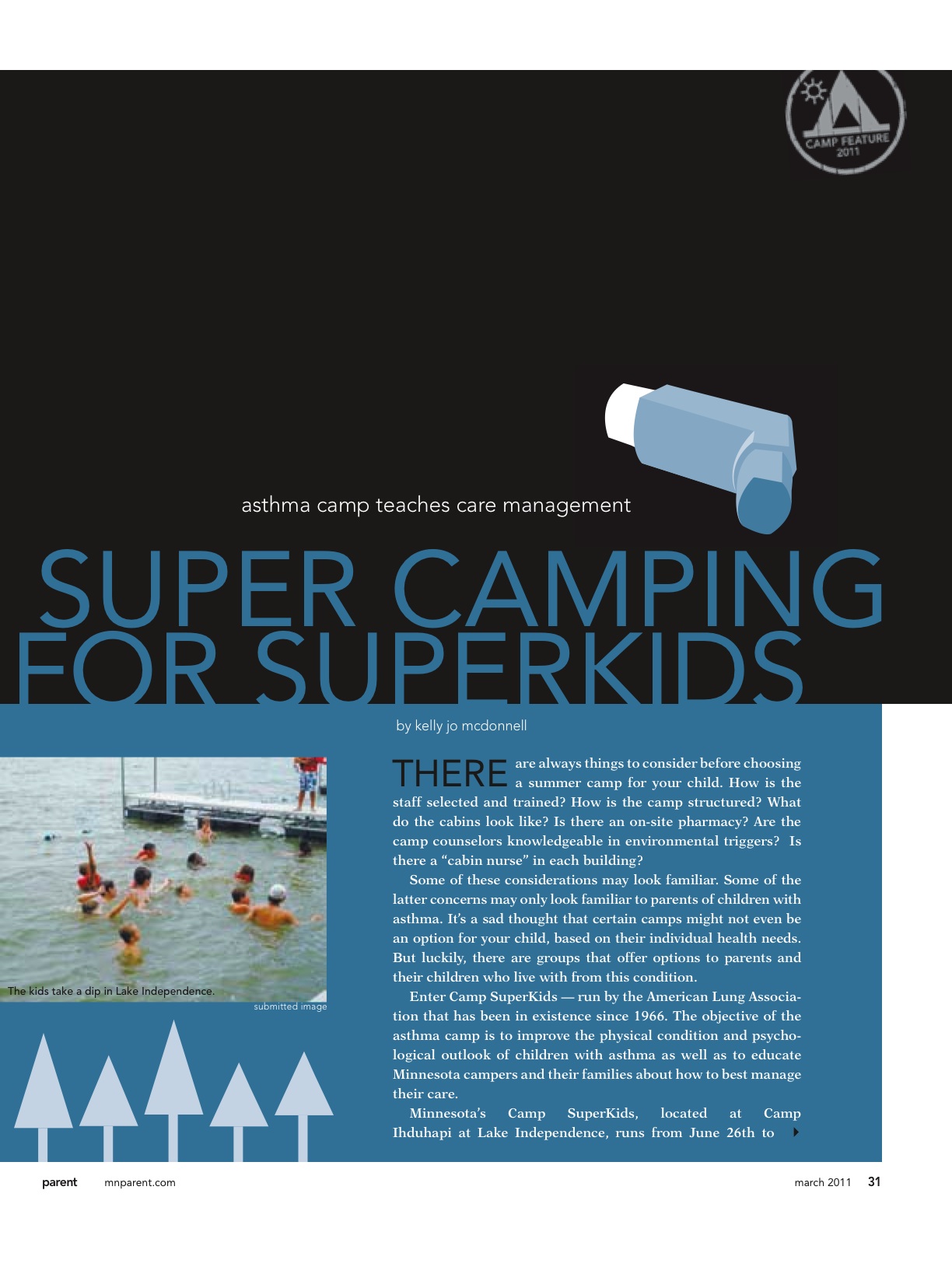
There are several items to consider before choosing a summer camp for your child. How is the staff selected and trained? How is the camp structured? What do the cabins look like? Is there an on-site pharmacy on site? Are the camp counselors knowledgeable in environment triggers?  Is there a “cabin nurse” in my child’s cabin?

Some of the concerns may look familiar. Some of the latter concerns only look familiar to parents of children with asthma. If your child suffers from asthma, the list of concerns is a long one. Some Summer Camps might not be an option for your child. But luckily, there are groups such as the American Lung Association that are offering options to parents and their children who suffer from these conditions.

Enter Camp SuperKids – a camp run by the American Lung Association that has been in existence since 1966.  The objective of the asthma camp is to improve physical condition and psychological outlook of children with asthma as well as to educate Minnesota campers and their families about how to best manage their care.

Minnesota’s Camp Superkids, located at Camp Ihduhapi at Lake Independence, runs from June 26th to July 1st in 2011. The kids that come to this camp have moderate to persistent asthma, meaning the children need a daily controller medication. If the child has very severe asthma (ie: been to the emergency room in the last month of the camp), the Camp recommends the child sit the camp out, and will help the child get ready for the next year.

While this camp has the same fun outdoor activities as other camps do, it offers something a little bit more. Peace of mind for the asthmatic child and his or her family.

“We provide all the camp experiences,” explained Cynthia Peat, Director of Camp Superkids and Manager of respiratory health at the American Lung Association in Minnesota, “they still get to go swimming and canoeing and hiking and zip line. They participate just as any other YMCA camper would.”  While these normal summer activities are a staple for a summer camp experience, they also can be “triggers”. Mother Nature has her share of triggers for the asthmatic child, including pine, grass, pollen, ragweed and more.  The great outdoor experience can turn into the great emergency room experience in a very short time. But at Camp Superkids, all camp counselors are aware and ready.   “That (triggers) is a huge concern,” said Peat, “our goal at the end of the camp is for the kids to recognize and understand that they have to take good care of themselves, and to know what to do around their triggers, so they understand. A lot of kids who has asthma don’t go as fast, or develop as quickly, and parents will shelter the kids from a lot of things. The bigger goal of the camp is to tell kids that they can! Just take precautions”.

The precautions are subtle, but straight forward. Some examples are:

  • There’s a “cabin nurse” assigned to each cabin.
  • Kids check their meds into the nurse. Meds are distributed twice a day
  • There’s an on-site pharmacy, and an on-site doctor 24 hours a day
  • For every 8 campers, there’s one medical staff at all times

At Camp Super kids, the camp counselors are not only specially trained in asthma, most are sufferers themselves.  Joey Cuttoo, Camp Manager, started at Camp Super Kids when he was 7 years old, and suffered from persistent asthma. Cuttoo attended all the way up until he was involved in the Jr. Leaders Program for teens. He now manages the entire camp, and helps with the training of camp counselors. “We work closely with Joey Cuttoo,” explained Peat, “there’s a training program the couple weeks of May, one of our doctors do the run-down. They have a good baseline, then there’s a Sunday review session before capers arrive. There’s a counselor for every cabin of 8 to 10 kids”.

Peat said the children absolutely love taking part in the camp experience. “They go swimming, they zip line, there’s bonfires with camp songs, hiking, there’s a climbing wall, and one night they got to go on a camp out on an Island,” said Peat, adding that there’s a physician on every boat, and a tackle box of emergency supplies along for the trip.

While the kids may only be interested in the fun, outdoor activities, Camp Superkids also offers a little bit of education for their campers. After Dinner the campers will get some Asthma education in the form of games. An example is “Lung-Go” which is like Bingo, except you have to answer questions that are asthma related.  The campers learn what asthma is, how asthma attacks start, how they can avoided, and how asthma can be better managed in the future.

While children of all ages can suffer from asthma, the American Lung Association recommends children ages 7 to 15 attend Camp Superkids. (and 15 and beyond can be involved in the Jr. Leaders program at the the camp) The camp does target the entire state of Minnesota. About 1/3 of its campers come from the inner city, another 1/13 from suburbs and the rest come from greater Minnesota. 80% of the campers receive ‘camperships’, which are offered to low income families. Most of these families often lack the resources or don’t have health insurance to visit the Doctor’s office for their children’s asthma. “We want to make sure we won’t turn away any child who wants to come,” explained Peat.

Camp Superkids can be a challenging camp to run, and Peat sites the coordination of the medical staff is the biggest challenge as well as its highest priority. “We have a medical board, and everyone is on the same page,” said Peat, “we coordinate enough volunteers to help staff the medical part of the camp.” She added, for example, that pharmacy students from the Children’s Hospital volunteer their time in the service center and pharmacy, and nurses, allergists, pediatricians, and respiratory experts volunteer their time a well, with the majority of them coming from the Mayo clinic in Rochester, MN.

Above all, Camp Superkids is fun, and their campers learn that they’re not alone with their asthma and that there are kids out there just like them.  Peat said that the greatest reward for running the camp is the fabulous stories she hears from both the children and the parents. “The kid returns from camp a different person…really being able to take indpendent care of themselves. It’s the best to hear! I’ve already been getting calls on when the camp is this year”.

Registration for Camp Superkids begins February 1st.  For more information go to www.lungmn.org (once on the main page, go to “Programs”, and then “Asthma Camp”)

Price – $495 for 5 nights
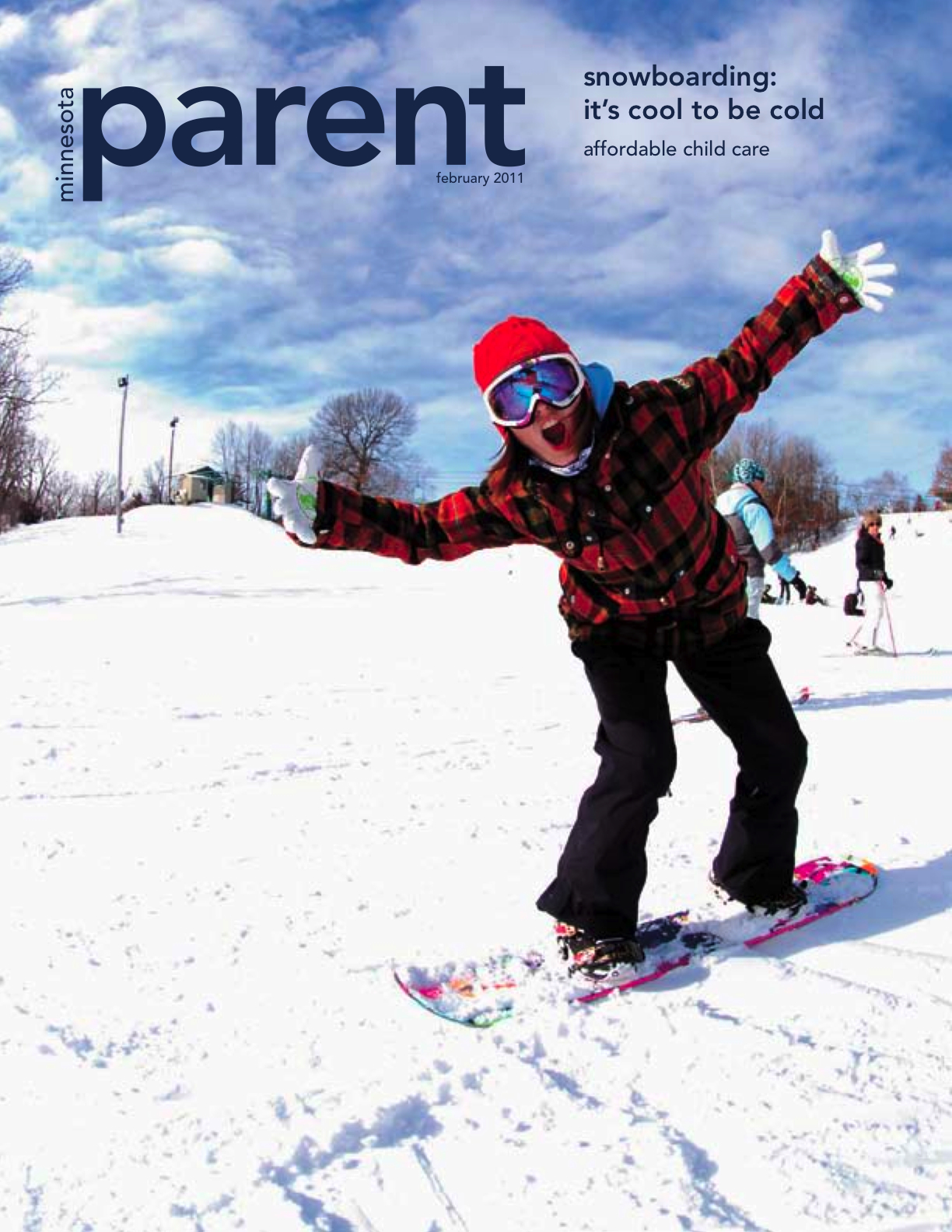
It’s Cool to be Cold (MN. Parent Magazine-March Issue)

Beginning Snowboarding

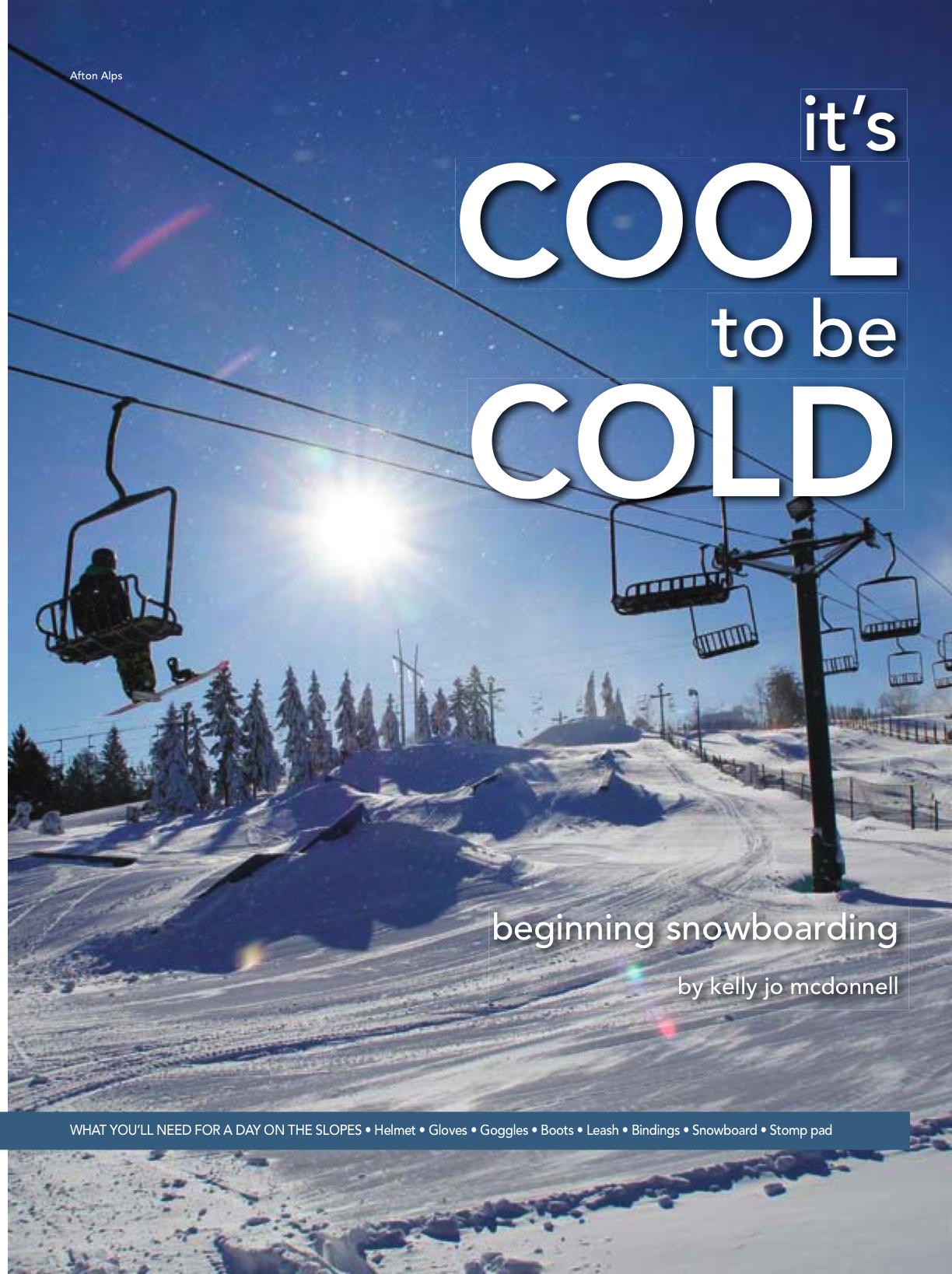
It’s 20 degrees outside on a sunny Saturday afternoon — where do you want to be? Under a blanket reading a book, while your kids play Wii? That seems about right, doesn’t it. When temperatures drop, families stay inside. The lure of the out-of-doors better be pretty good to get kids bundled and families out for a full day of brisk weather.
While there are numerous winter sports (skiing, sledding, snowshoeing) to tempt anyone away from a blanket or television set, snowboarding is at a peak in popularity. Just look around any of the area’s resorts and you will see countless skiers; but pay attention and you’ll notice just as many snowboarders.
It’s believed the first snowboard was developed in 196 5, when Sherman Poppen made the “Snurfer” (a contraction of the words snow and surf) by bolting two skis together — as a gift for his daughter on Christmas Day. But it wasn’t until the mid-1990s that folks starting seeing snowboarding in a new light, when it was added to the 1998 Winter Olympics in Nagano, Japan. Now, ask any young kid whom Shaun White is … you’ll get an immediate and informed answer.
learning the slopes
These days, snowboarding is the ultimate cool. And my son, Hayden, even at age eight, is well aware of the sport. While he has enjoyed other winter activities (sledding, tubing), he wanted to learn how to snowboard.
Enter Mike Chenoweth and Chad Hoag, snowboard instructors at Trollhaugen Ski Resort, right across the border in Dresser, WI. Trollhaugen has customized weekend programs for kids: “Little Trolls” (for ages four to five) and “Trolls” (skiers age six to 12 and boarders ages seven to 12). Regular lessons are available seven days
a week.
This place is super-handy, as families can rent everything they need on site, and have a coach/instructor help along the way. Hoag immediately put Hayden at ease, explaining he was going to set him up with his snowboard and other necessary gear for the day. As we walked to the rental area, we passed the ski shop and Hayden eyeballed the colorful snowboards. I was eyeballing the price tags. A “Ripper” snowboard was on sale for $199.95 instead of $229.95. “It’s on sale!” said Hayden.
Hoag steered us away from the shop, explaining that his charge would be starting with a trainer snowboard, which as it turns out is quite a bit heavier than the average snowboard, and much less colorful. &ldqu o;Can you wiggle your toes?” he asked Hayden, as he was putting on his boarding boots.
Hoag explained that age eight or nine is a great age to learn skiing or snowboarding. “This year we’ve started a program for younger kids, four and five and six,” he explained, “but the expectations are a little bit different at that age. They don’t have all the fine motor skills.” He added that children of Hayden’s age might have trouble with being “squared up” on the board and not “sitting in the back seat.” He explained that with skiers, the torso, chest, and head primarily face down hill as they ride. For snowboarders, they slide sideways down the hill, so they need to remember to keep the torso and chest parallel to the snowboard and turn just the head to look in the direction of travel. “‘Sitting in the back seat’ is a term used when snowboard riders put more wei ght on their back foot instead of their front/lead foot,” explained Hoag. “It is usually associated with a fear of going down the hill; so new riders will have a tendency to lean backward on their board.”  The sooner a new rider can learn to keep slightly more weight on their front foot, the quicker they will progress with their riding.
Once my son was all laced up, he followed Hoag to the practice slopes, talking excitedly about snowboarding. “It’s just the pure joy of ‘surfing’ down the hill and enjoying the outdoors,” Hoag told me. He locked in one of Hayden’s little feet on the board, and began running through basics, such as how to walk along with the board, and most importantly, how to fall correctly. They first practiced falling forward. “Not on your elbows,” reminded the instructor, stressing it’s best to fall forward on the knees and forearms when moving in that inevitable direction. Falling backward came a little easier for Hayden. “Fall on one cheek or the other,” said Hoag, “and don’t hit your tail bone.”
Once falling was mastered, the two worked on maneuvering the snowboard, which is much more difficult than it appears to be — especially for a 50 pound, eight year-old. While Hayden worked on this new skill, several young kids “hopped” past him, snowboards locked on both feet, trying to get to the tow rope. One determined boy simply fell to his knees and crawled to the rope, not wanting to unlock his feet to maneuver correctly. Hoag kept Hayden grounded, reminding him, “We’re going to be safe first, we’re going to have fun, and along the line we’re going to learn something.”
balancing act
Once my son could get around, he next worked on standing on the board correctly, which initially seemed to be quite a balancing act. Grabbing the rope to go up the test hill was another feat in itself, but he held on for dear life as his coach shadowed him all the way up. Once on the top, Hoag again ran him through the “falling” rules. And it was a good thing, as on the first trip down my son made it halfway, and then fell quite spectacularly. “Good job!” said Hoag, who was right behind him. This went on for about an hour, until Hayden slowly worked his way down the hill without a tumble. He even made it through the “hoop” at the bottom (a hula-hoop type of arc at the bottom that skiers and snowboarders try to pass through).
It was about 20 degrees that day, so at the end of the two-hour lesson, we congregated at the Kids Lodge (also known as The Learning Center) to warm up with hot cocoa. Mike Chenoweth (the supervisor and lead clinician), checked in, and he and Hoag discussed how the lesson went. Their enthusiasm for snowboarding and Trollhaugen is infectious, and both are excited about the Learning Center Program. “This is not just for kids,” said Chenoweth, who began snowboarding in 1988. “What we see is too much inactivity. Folks bring their kids out here; they’re enjoying winter. Mom and Dad — let’s enjoy winter with them.” Coach Hoag said that he and the other instructors all want snowboarding to be a sport the whole family can enjoy. My son asked him when he could go down the big hill. “Next time, buddy,” Hoag said.
On the way out, we booked Hayden’s next snowboarding lesson. Who knows, the 2020 Olympics aren’t that far away.
Kelly Jo McDonnell is a writer based in the Twin Cities.

Where to board
Every slope will have something different, so be sure to check websites or call for more information.
Afton Alps
6600 South Peller Ave.
Hastings, MN 55033
800-328-1328
Buck Hill
15400 Buck Hill Rd.
Burnsville, MN 55306
952-435-7174
Hyland Ski and Snowboard Area
8800 Chalet Rd.
Bloomington, MN 55438
763-694-7800
Lutsen Mountains
P.O. Box 129
Lutsen, MN 55612
218-406-1320
Mount Kato
20461 Highway 66
Mankato, MN 56001
507-625-3363
Trollhaugen
2232 100th Avenue
Dresser, WI 54009
715-755-2955
Welch Village
26685 County Road 7 Blvd.
Welch, MN 55089
651-222-7079
Wild Mountain
37200 Wild Mountain Rd.
Taylors Falls, MN 55084
651-465-6315
What you’ll need for a day on the slopes
• Helmet
• Gloves
• Goggles
• Boots
• Leash
• Bindings
• Snowboard

• Stomp pad

Time to Ice Fish

Kids & Ice & Fish?

It’s cold outside.  But we Minnesotan’s have plenty to keep us busy. We have 10,000 lakes (now ice) and they are full of fish. How about combining the two for some family ice fishing? Not sure where to start?

It’s not as hard as you think. Here are some hard and fast pointers on making it happen:

  • Getting Started: get a guide (and/or a seasoned Grandpa, Uncle or friend)

Especially if this is the family’s first time out, a fishing guide is worth his/her weight in gold (and fishing gear). And it’s much more economical that one would think. A fishing guide will take care of a whole list of fishing gear families may not have thought about, including:

–       Ice fishing house –  (guides will usually have permanent ones that will keep the wind and cold at bay, and perhaps even have a little heater inside) If not, sitting on a bucket on the ice works well enough, too.

–       Rods – The guide will use a short rod if your in an ice house; they let the fisherman sit closer to the ice hole, and they also let the fisherman set the hook easier. Longer rods can be used if you’re sitting on a bucket out on the ice. (Home Depot has nice 5 gallon buckets for cheap that can be used to carry your gear, then to sit on)

–       Ice Drill – This is for cutting through the ice to fish, and it also helps to have a slush remover to clean out the ice hole. Remember: four inches of ice and deeper for walking on the ice, 6 inches for an ATV, 12 inches for a car or pick up.

–        Forceps/needle nose pliers – your guide will use these to help you with hook removal

–       Bait – should be kept on the small side, and include minnows, crawlers or small moth larvae (otherwise known as waxies) but your guide will have all the bait on hand already. The guide will also have ice-fishing lures on hand as well.

–        Know your fish: the guide will also act as a teacher of sorts, and be able to help out with fish identification. Did your son just catch a perch? Or your daughter a walleye? Might be fun to get a Fish ID book to bring along (one that can be read with mittens on)

Safety. Clothes and Manners

–       Know where you are on the ice, and set boundaries. (ie: look for holes in the ice) Although your guide will know, it helps for everyone to know the area-carry a phone, compass, map or GPS unit. The guide will have your locations mapped out for you, and will know the best “honey holes” to fish. Ice Fishing takes place on ponds and lakes of all sizes, with safe ice of course. Larger water bodies will provide more of a diverse fishing opportunity for your kids. Most state-owned lakes do allow ice fishing, while county or municipally owned waters may prohibit it.

–       Keeping your feet warm and dry will be the first priority-get the kids (and yourself) heavy, felt-lined boots and wear thick, wool socks. Maybe tuck an extra pair along just in case of cold, little toes. Stocking caps are a must, try a knitted or fleecy hat that covers ALL the ear. A scarf or muffler helps, as well. For gloves or mittens, remember that mittens tend to trap more warmth than gloves, so find some mittens that are thick. Layer up thin gloves underneath the mittens for some extra warmth. This also works well when the kids have to take off the mittens to either tie a knot, or take a fish off the hook.

–       Manners aren’t just for the table. The fishing guide can be helpful with etiquette, but some rules of the road include: don’t set up too close to another fisherman unless you ask first, keep your fish in a bucket with some water and slush or release them before they freeze; don’t blast your radio or litter; and the big one: Do not make a lot of noise, it can spook the fish!

This is Fun Remember….

Keep in mind these are kids that are fishing. Keep the sessions short, 4 hours max.  Plan a big lunch for a slow bite day, maybe even bring a grill and have a hot dog cookout on the ice! Some other tricks for kids include having them use a hand auger and let them try making the hole; be sure to pack some warm, sweet liquids like hot chocolate; try out a underwater camera (like the AquaVue) to get a real view of what’s happening underneath the ice.

If families are interested in more group events, check out the Minnesota DNR’s website at www.dnr.state.mn.us/events and/or www.dnr.state.mn.us/minnaqua/icefishing for a complete calendar listing of winter ice fishing events, including Winter Trout Fishing, Ice Fishing 101, Fishing Derbies, and Take a kid ice fishing clinics. For ice safety, check out www.dnr.state.mn.us/safety

Holiday Funk?

As the festive holiday season approaches, it can bring out many feelings and emotions.   Some are as toasty as hot chocolate and some are well….funky.

From the get-go of the holiday season, the race begins. (which is now, according to retailers, right before Halloween) Mothers feel the pressure to be at the top of their game. It began for me when I was packing away Halloween decorations with my 8-year-old son.  He was exuberantly bringing out Christmas decorations as I was trying to stuff the fall decorations in their boxes. In one crate he found all the Holiday CD’s, season scented candles, and THE Christmas book. No, not the Bible (although that should be what I’m talking about). It was my hardcover Martha Stewart coffee table book, appropriately labeled “Handmade Christmas.” It has a place of honor on my coffee table during the Holidays, you see, and it always adds the appropriate amount of extra pressure. It’s already probably over 10 years old, but its full color, it’s sleek, and it’s chock full of “ideas” on how to make the best wreath or swag, or crafting your own handmade scented gifts out of flavored sugars or making potpourri sachets.  My son reverently handed it to me. I took it, not quite ready for the responsibility that comes with this book every year.

Do my berry wreaths and orange clove scented project look like the samples in the book? Not by a long shot. But I keep trying. Trying for that beautiful, flawless picture in the book…and you know the ones I’m talking about.  Some years ago, when that book was brand new, it bothered this Mother that my picture didn’t match the book. Why did my gingerbread house look like something out of a Tim Burton film? Why was my hand made pinecone garland dropping cones on people’s heads as it hung over the front door? The pressure to make everything perfect for our families at the Holidays is an enormous one. By the time all the gifts are unwrapped, the tree needles start to slowly drop to the carpet, and that last Holiday CD is playing for the one-thousandth time, Mothers feel the burn – the burn out, that is.

Perhaps Moms need to sit back and slow down during the holiday season. There’s a news flash. Take a look at what we really have, and not stress out about the occasional imperfections of our holiday visions. It would make life more enjoyable, and there wouldn’t be such a post-Holiday crash at the end for both Mom and child. (or children) But cutting back on our perfect vision isn’t easy. We all have our ideal Holiday scene in our head. Don’t let go of that pretty visions altogether, but maybe be open to the vision changing as the season comes and goes. Flex-vision. There will always be circumstances outside of our control that pop up. That’s life. How we react to it is the key to our survival as Moms-who-do-it-all. If we sit down at the end of the Holiday journey and take a look at the vision that was created, we usually find that it doesn’t exactly match that Martha Stewart vision in our head. The Christmas snowman my son and I made with Grandpa and Grandma had deer antlers on his head. Son and Grandpa were thrilled. Mom and Grandma were mortified.. And that’s OK. Flex vision. It’s the key to making a pain-free transition from holiday season to post season

While Moms are busy trying to make the perfect Christmas, we bring our children right along with us for the ride. The aftermath of January can be brutal, and not just weather-wise.  After holding that perfect vision in our head for so long (and ultimately, the vision seeps into our children’s heads as well), when the Holidays end, it can feel a tad empty. Void. The whole family’s routine has been moved around to make way for this vision, now how do we get everything back on track? These tips can help. Some will be do-able for you, and some will not. Every family is different.

Four tips on gracefully returning to life POST Holidays

Spending limit

There’s nothing more Scrooge than talking about money during the Holidays, but in this economy, it’s a necessity. Financial pressures can stress Moms out faster than burning the Christmas cookies. Take stock of how your checkbook looks around October or November, before the madness starts. Knowing your spending limits can help take the stress out of buying gifts all on credit. And that credit card will be leering at you in January as you pay finance charges on those perfect gifts. After a divorce and becoming a single Mom some years ago, I had to eat some humble pie, and opt for more economical gifts for my family. But it taught me to shop smarter, appreciate what I had, and realize that smaller gifts are just as good. And more importantly, it taught my son a respect for money. You respect it more if it’s not there as often. Tell your kids to be realistic, and make sure they realize some sort of gratitude for it all. Heck, I told my son, even Santa has to operate on limited funds…look how long his list is. Which was followed with his question, “how much does Santa make”?  Moving on….

–       The return to School

Our children have been enjoying a holiday break from school, and are less than enthusiastic to return to the classroom. Holidays can disrupt homework and class assignments. Luckily the teachers, who are usually Mom and Dads themselves, take note of the craziness of the holidays and don’t load the kids with too much homework. But don’t take a complete break, even though it’s tempting. If there is an assignment, attempt to complete it at the beginning of the vacation holiday, and then circle back to it at the end to review. Board games with family and cousins can also be a great way to keep the brain cells sharp during the holidays, and they won’t even know their learning! Read Holiday books during Christmas, but then return to their favorites come January-they’ll be excited to return to some normally and routine, too, even though they don’t really understand why.  Although my son is sad to see Peef the Christmas Bear books be packed away, he’s excited to pick up where we left off with Diary of a Wimpy Kid, or the next Harry Potter book.

–       Back to Sleep!

This one anchors all the rest. And we as Moms know it. Nothing makes Moms feel scroogier than a tired, whiny child. And while sleeping is the simplest, most natural thing our children can do, around Christmas time it can be down right impossible.

Regaining our children’s sleep schedule, as well as our own, will make post-holiday living much easier. And to help regain the control, we must attempt to do this during the season. Keeping a little slice of routine into your children’s schedule, even a sliver, will help with getting them back on schedule come school time. My second grader, on a school night, is in bed by 7:30 p.m. During the Holiday season, I attempt bedtime procedures around 8:00. (it does help if cousins are also on the same routine, or this one can bet sticky) If bedtime is pushed closer to 9:00 or 9:30 p.m. it’s not the end of world. Just try to keep the bedtime routine the same (bath, books) during the break. This helps with their familiarity of  bedtime, even if your at Grandma and Grandpa’s house.  The transitions back to the 7:30 p.m. bedtime won’t be so tricky come January. Even though it’s difficult, this Mom also tried to hit the hay halfway early. Just because the kids are going to bed later, doesn’t mean they sleep in late. Especially during this season. So try to turn in earlier if you can, or make sure there’s strong coffee made in the morning.

–       Diet/Exercise?

Get real, right? The holidays are all about taking a break from the gym and savoring family time (as well as those holiday goodies). Kids, too. If there’s no down time to squeeze in a little work out, don’t sweat it. Frolicking with your kids in the snow, or building a snowman, pulling them on their sleds, works for a cardio work out, too. Moms are usually going 100 miles an hour anyway during the Holidays, so bottle up a little of that Martha Stewart energy and look at it as “you” time…with your kids. They naturally have that energy bottled up, and amazingly, never seem to run out. Take a page out of their book, and move along with them. Get some fresh air. Those cutout, frosted cookies taste so much better after coming inside from the cold! Reminder: try to slip in some healthy snacks in between all those goodies…for both Mom and child. It will help with that bottle of energy- it’s tough to get my son to eat some orange or peach slices when he’d rather grab some chex mix. But he’ll do it. And so will I. Santa is watching.

Be flex with all the tips above. Do what you can, when you can….and don’t let Santa catch you berating yourself for falling short. Regaining even a little routine during the busy holiday season will help everyone transition into the New Year.

And by the way, that horned snowman has a place of honor in my son’s memory. He didn’t match the fancy snowman example in my Martha Stewart book, but he was just as good if not better. Go figure.