R is for Raingarden!

Improving water in several ways

  • Article by: KELLY JO McDONNELL , Special to the Star Tribune
  • Updated: August 9, 2011 – 4:42 PM

Three new rain gardens at a Lino Lakes school, a collaborative effort of agencies and students, are filtering storm-water runoff and helping kids learn.

hide

Rice Lake Elementary students planted a rain garden on the school’s property in June.

Students at Rice Lake Elementary in Lino Lakes have added a fourth “R” to the fall curriculum:

Rain garden.

Before summer vacation started in June, teachers and students at the K-5 school joined with folks from the Rice Creek Watershed District (RCWD) and the Anoka Conservation District and built three rain gardens on the school’s property.

The school sits right next to Rice Lake. “It’s a great location to do it,” said Principal Warren Buerkley. “It was exciting for us; we had three grade levels work the project into their curriculum. The teachers got on board with it right away.”

Part of the Watershed District’s mission is to prevent flooding and enhance water quality. The rain-garden plan arose out of an assessment done to identify cost-effective projects to treat storm-water runoff before it goes into Rice Lake, said Nate Zwonitzer, conservation specialist for the Anoka Conservation District.

The city of Lino Lakes approached the school to gauge interest in making the rain gardens. “We said we’d be happy to with work with them,” said Buerkley. “After that the RCWD went out and got grant funding and we all took it from there”.

“There was runoff from the parking lots and buildings at Rice Lake Elementary,” said Kyle Axtell, water resources specialist with the RCWD. “So the goal is to intercept that runoff as much as we can, and get that water infiltrated into the ground. … It has to go through the ground to reach the lake”.

The three garden locations were picked, a contractor was selected, and the gardens were built, said Zwonitzer. Something that posed a challenge for the rain gardens was … rain.

The extremely wet spring raised the possibility of the gardens holding water longer than they should, Zwonitzer said. So one garden was made shallower than originally designed.

As for the students, “they all had fun” said Buerkley.

“Some were planting, while some were working in a classroom, some in an outdoor setting, learning about watersheds and wetlands, and how water is purified. It was very hands on,” Buerkley said.

Axtell said he was impressed with Rice Lake students and teachers. “They had around 90 students,” he said. “It was really just a good day for everyone. The students were learning different things related to the rain gardens, and now the rain gardens will be able to be used in the science curriculum at the school moving forward.”

The school, its students and faculty will be responsible for the gardens’ maintenance for the next 10 years. Buerkley said that some Boy Scout troops are doing some basic weeding this summer and that, come fall, the students will take over again.

Zwonitzer said the project “was a great example of different government organizations working together to get something done.”

A tough piece of history

Stillwater collector: ‘I want to make people aware’

  • Article by: KELLY JO McDONNELL , Special to the Star Tribune
  • Updated: July 23, 2011 – 9:54 PM

Tony Carr’s collection of black memorabilia may strike a nerve, but he says the pieces are good teaching tools.

hide

Some of the pieces that Tony Carr has collected over the past 20 years.

Photo: Cy Dodson, Star Tribune

Tony Carr collects history, but it’s a piece of history that’s tough to view.Items in Carr’s collection include “Pickaninny Peppermints,” piano sheet music entitled “Coon Coon Coon” and a large saluting KKK figure in full garb.Carr, a former professional basketball player and current Stillwater resident, began collecting black memorabilia about 20 years ago.

“People ask me, ‘Why do you do this?’ ” says Carr. “Because it is history. But there’s no finger-pointing, it’s not about that. It’s about everyone’s struggle, and what my family went through.”

He has chronicled those family struggles in a book, which will be published late this fall by Mill City Press.

He said his parents couldn’t even view some of the pieces in his collection. “I’d show them a piece, and it would bring back memories,” he said, “It was a part of their life. They lived through this.”

The collection is displayed in the downstairs family room of Carr’s home. There’s a lit case on the back wall, and several items displayed here and there around the room. Carr said most of his collection is stored in boxes.

“My first piece was an Aunt Jemima salt and pepper shaker. I bought it down in northern Illinois for like 50 cents,” Carr said.

After that, he started paying attention and noticing other items. “I’d see a piece, an ash tray, and wonder ‘Where did that come from?’ I did my research, and that got the juices flowing.”

Carr’s passion and enthusiasm for history and his collection are obvious.

“Collecting is something I’m very passionate about,” Carr said. “There’s never a dull moment, always new stuff popping up that you never knew existed.”

Passion is apparent in all aspects of Carr’s life. He grew up in Beloit, Wis., and was a star athlete.

“I grew up in the north, and I’m a product of integration,” he said. “I was put in an all-white school, but I knew I had to assimilate and survive. One of my survival skills was basketball … that brought me up the ladder.”

He was a two-time all-state player in Wisconsin, and was recruited by several Big Ten schools. He ended going to the University of Wisconsin-Eau Claire, where he was a three-time All-American and still holds numerous school scoring records. He went on to become a member of the U.S. Olympic basketball trial team, and in 1982, he was drafted by the Milwaukee Bucks.

He signed a one-year contract, but Carr said he became disillusioned with professional basketball. He left the Bucks and went to work for Merrick, Inc., where he spent 18 years working with the developmentally disabled. Currently, Carr is the Director of Community Programs for the American Red Cross, Twin Cities Area Chapter. He also served as the chairman of Stillwater’s Human Rights Commission until 2009.

His current favorite pastime is going on the road and speaking about his collection, especially in schools. It’s a chance for him to share the dehumanizing images in an effort to teach others about the struggles of his parents and grandparents.

“I don’t want to change people. I want to make people aware,” he said. “Be aware of what we say and how we say it. It makes me feel good.

“If my mom and dad knew I was showing this stuff in big arenas …” he laughed, shaking his head, “This keeps them alive to me, and this is no joke, I feel that they are right there.”

His collection brings out all sorts interested onlookers, including some one wouldn’t expect. Carr said that during a UW-Superior speaking engagement, members of the KKK showed up to authenticate his Klan statue.

“They [school officials] said, ‘Mr. Carr, would you like to not have these people come?’ … I said, ‘They’re a part of community. Let them come.’ They hung out afterwards, and maybe we all left a little bit more aware.”

Kelly Jo McDonnell is a freelance writer from Lino Lakes.

Racing is in her blood

Racing is in her blood

  • Article by: KELLY JO McDONNELL , Special to the Star Tribune
  • Updated: July 5, 2011 – 2:06 PM

Following in her granddad’s and dad’s footsteps, Anna Kouba looks to make her mark on dirt tracks, including Elko next week.

Sprint car racer Anna Kouba , 19, of Lino Lakes, received some help from crew member Keith Hodnefield strapping into her car before the start of her heat at the dirt track in Princeton, Minn., on June 25.

Anna Kouba has been drawn to the family business since she was 8 years old.

In her family, the business is driving cars — race cars — at triple-digit speeds on a dirt track.

Kouba, 19, of Lino Lakes, is traveling a path blazed by her grandfather, Earl Kouba, in the 1940s and ’50s and continued by her father, Joe, and brother, Joseph, as well as her Uncle Jimmy.

“My whole family is basically in the racing gig,” said Kouba.

Earl Kouba is in the Colorado Motorsports Hall of Fame, and her dad, who raced for more than 30 years, founded the Upper Midwest Sprint Car Racing Series. “I race under that sanction,” she said.

This is Anna Kouba’s rookie season, and she wants to race into October. She’s been in about a dozen races and has some top 10 finishes to show for it. Her next scheduled racing is coming up at Elko July 15 and 16.

Sprint Car Racing isn’t cheap. Most of her winnings go back into maintaining her car. For race day, average transportation and fuel costs run about $350.

“The more I perform, I’ll be able to get more sponsorship,” she said. “The ultimate is getting a full-ride sponsorship, like the professionals, but ours comes from our own money mainly.”

Joe Kouba said his daughter definitely has the drive and commitment to excel in the sport.

“Anna is extremely competitive,” he said. “She’s gotta beat her brother first and see where she can take it.”

Anna will learn patience as time goes on, he said. “When she doesn’t do well, she gets mad at herself and the world… It’s a fine balance,” he said. “Life has a tendency to teach you that you can’t always run down the hill, you have to walk sometimes. If she’s patient, I believe in my heart I can get her beating and racing with the local guys.”

At this point, it’s almost all guys she’s facing. “I’ve only raced against one other woman,” Anna said.

There are advantages and disadvantages to being the only woman on the track. She especially likes it when young girls come up and talk to her. “It’s pretty fun to see the girls cheering for me because I’m a woman.”

On the other hand, she said that sometimes she’s not taken seriously enough. But she brushes it off. “I’ve grown up with men and this sport. Besides, my friends think it’s really cool.”

Her drive to succeed isn’t just in racing. She was a soccer standout at Centennial High School and went to the University of Wisconsin-Green Bay on a Division I scholarship.

This fall, though, Kouba will be transferring to the University of Wisconsin-River Falls to be closer to home, racing and her mother, Kathy, who slipped on the ice last year and suffered a serious brain injury. Today, she is almost fully recovered.

Kouba’s plans for the future are right in line with her racing passion. Her main priority is to finish college, where she is majoring in marketing and communications. “If for some reason racing doesn’t pan out, I still want to be involved in racing in some aspect,” she said.

For now, her racing goals are to keep making progress and someday make it into the “World of Outlaws,” the professional league for sprint car racing. “Either that or going in NASCAR and getting a sponsorship,” she said excitedly. “I just want to be in racing.”

Make Fishing a Family Affair

Special to the Star Tribune

Several small lakes in Washington County offer youngsters a chance to take part in the state’s fishing opener on the cheap and close to home.

Families who want to take part in the state’s fishing opener next weekend but don’t have the time or the money to head Up North can find several entertaining spots in Washington County. A picnic lunch might provide a nice distraction — and help build some memories — if the fishing gets a little slow. Here are five family fishing holes that aren’t far from your back yard.

Powers Lake

Location: Woodbury, Powers Lake Park, Fox Run Road and County Road 19

Size: 58 Acres Maximum depth: 41 feet

Park entrance fee: No

How to fish it: Catch pan fish by using a bobber and worm right off the fishing pier.

There is a formal canoe/access carry-in area and an impressive fishing pier.

What they say: “I’ve fished for panfish with my daughter right from the pier,” said Jim Levitt, DNR Fisheries and Wildlife’s Fishing in the Neighborhood Program director. “It’s the best fishing lake in Woodbury.” Fish species include bluegill, largemouth bass, northern pike, walleye, yellow perch, black crappie and bullhead. Power Lake also has a playground, a picnic shelter pavilion and a trail that goes around almost the entire perimeter.

RAVINE LAKE

Location: Cottage Grove, Ravine Regional Park, County Road 19 and Hwy. 16

Size: 19 Acres Maximum depth: 15 feet

Park entrance fee: Yes

How to fish it: Try a minnow or a leech for walleye; cast off into the deep water from the pier. (Water is deep off the Ravine pier) Does not have a designated boat or canoe launch area.

What they say: Many consider Ravine Lake to be a hidden gem that has nice walleye and largemouth bass. Even though it doesn’t offer as many species as Powers, anglers can find bluegill, black crappie, largemouth bass, walleye and bullhead. Families can fish from the pier, or from paved walking paths along the lake. It’s a county park, so it has trails and picnic pavilions.

SQUARE LAKE

Location: Square Lake is located 7 miles north of Stillwater in the city of May

Size: 203 acres Maximum depth: 68 feet

Park entrance fee: Yes

Boat Access: Yes

How to fish it: Around the pier, it’s open and doesn’t have a lot of vegetation. Try casting a spoon for the trout or pike.

What they say: The lake is known for it’s fishing, as well as its scuba diving. The lake is spring fed, and the water clarity is superb for divers. “It gets stocked with trout, rainbow trout, and also has northern pike,” said Levitt. “The pike can get pretty good sized in there.” Species also include largemouth bass, bluegill, crappie, bullhead and perch. It also has a first-class swimming beach.

TANNERS LAKE

Location: Oakdale, east of Hwy. 120 and north of Interstate 94

Size: 70 acres Maximum depth: 46 feet

Park entrance fee: No

Boat access: Yes

How to fish it: When it warms up, there’s a lot of lily pads around the pier; try a surface lure for large mouth bass.

What they say: The pier can get busy during prime times, but there are also several other family activities available. It’s a good-sized city park that includes ball fields, and a top-notch beach. Anglers will find a wide array of species, including bluegill, crappie, channel catfish, northern pike, largemouth bass, walleye and bullhead. Channel catfish were stocked in 2007, 2008 and 2009.

LOST LAKE

Location: Mahtomedi, Wildwood Park, County Road 244 and Old Wildwood Road

Size: 9 acres Maximum depth: 26 feet

Park entrance fee: No Boat access: No

How to fish it: Try a worm under a bobber.

What they say: Has pretty good fishing from a pier or off the shore. According to Josh Stevenson, owner of Blue Ribbon Bait & Tackle: “It’s a little gem. It’s tranquil, no jet skis or boats. Just fish. And it’s a nice park, an ideal situation for kids. It goes under the radar of most fishermen … Fishing pressure would be low, and that’s an added bonus. ” The DNR has stocked it with many crappies and bluegills in the past 10 years.

Kelly Jo McDonnell is a freelance writer from Lino Lakes.


Dr. Bruce the Bug Guy

Bugs are his business
  • Article by: KELLY JO McDONNELL , Special to the Star Tribune

Lino Lakes entomologist “Dr. Bruce the Bug Guy” takes his menage of bugs along with him to Twin Cities classrooms.

hide

Entomologist “Dr. Bruce” Giebink shone an ultraviolet light on one of his scorpions to show that they fluoresce a green color. This is a Black Emperor called Blackie.

Photo: David Brewster, Star Tribune

His name is Bruce Giebink. But, professionally, he’s “Dr. Bruce the Bug Guy.” ¶ “Well, the kids kept calling me the ‘bug man’ or the ‘bug guy,’ so I figured, why not?” Giebink said. ¶ The entomologist from Lino Lakes has built a successful business showing off his collection of bugs at schools. At a “Dr. Bruce the Bug Guy” show, kids can learn about hissing cockroaches while touching them, pet “Rosie” the rose-hair tarantula and get closeups of scorpions. They can even eat some bugs. Giebink says his edible bugs have been a huge hit the past few years.

“They’re special treats. I have meal worms — Mexican spice, BBQ and Cheddar cheese flavor!” he said.

Giebink has always had a love of bugs and everything outdoors.

“I was always a young naturalist,” he explained. “I grew up on a farm in Wisconsin that had woods, marsh and a pond. I thoroughly enjoyed being out in nature.”

It was that love that inspired Giebink to pursue pre-veterinarian studies at the University of Wisconsin in Madison in 1975. However, his interests changed halfway through, mainly because of biochemistry.

“The biochemistry did me in,” said Giebink. “I completed my undergrad degree in five years, and then did a lot of field research for my master’s. I completed my Ph.D. in 1987, which officially makes you an entomologist.”

Giebink ended up in the Twin Cities after accepting a research position with the University of Minnesota in 1990. However, it wasn’t until 1997 that Giebink got an idea of introducing his bugs to kids.

“I did a program for my son, who was in first grade at the time,” Giebink said. “They would bring in a parent and do a show for the class. My wife, Lisa, volunteered me to do it.

“It was so much fun, the kids had such a great time, and the teachers loved that it was hands-on and interactive. It got me off to a really good start.”

The next fall, Giebink started getting calls requesting the bug show from the Centennial School District. His hobby started turning into a full-time business. The Cub Scouts called. So did the Girl Scouts, nature centers and parents wanting him for their kids’ birthday parties.

Firm’s name: The Bug Zone

Giebink made it official in 2001, becoming “Dr. Bruce the Bug Guy,” and naming his company the Bug Zone. He targeted area libraries first. Coincidentally, the theme at the libraries that year was “What’s Buzzing at Your Local Library?” with a bug theme.

“That jump-started everything,” said Giebink. “I was getting wonderful exposure and was getting paid for the programs. It got me over the hump.”

Giebink keeps his bugs in a basement room specially heated and lit to keep them alive and flourishing. Among the room’s inhabitants are Madagascar hissing cockroaches, millipedes, centipedes, scorpions, tarantulas, cecropia moths and butterflies.

“June and July and August are by far my busiest months,” said Giebink. “September is a kind of transitional month, with summer programs winding down and school getting started. In the fall I get busy with Cub Scout and Girl Scout events, and right around Halloween I’m really busy with the creepy crawly theme.”

One of Giebink’s favorite bugs is the praying mantis. The kids’ favorite, however, might well be the tarantula.

“Kids really love Rosie the Tarantula,” he said. “It’s a very easy name to remember, and it’s a rather gentle name. She’s a rose-haired tarantula, Chilean, very beautiful. They have ideal characteristics for raising in captivity and for using in hands-on programs. Very docile, and not super nervous or skittish.”

Mainly, Giebink wants to get the message out that bugs sometimes get a bad rap.

“As a society, it’s kind of us against the bugs,” he said.

“If people learn to tolerate and co-exist, I think a lot of creatures in the natural world, insects included, would enjoy the outdoors a lot more.”

Kelly Jo McDonnell is a Minneapolis-based freelance writer.

Kids & bikes – 101

MN. Parent Magazine- May Issue

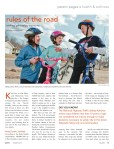
Kids love to ride bikes. And Minnesota loves bicycles. Minnesota has been ranked among the top “bicycle friendly” states in the country by the League of American Cyclists. The season is short, yes. So it’s time for families to take full advantage of the bicycling seasons. But before you dust off your bikes from their winter storage place, it’s a good idea to make sure your kids are aware of some basic safety concerns. It’s not rocket science, just learning how to stay safe on the road while on two wheels.

Safety 101

(note: children less than 10 years of age are not mature enough to make decisions necessary to safely ride in the street. Sidewalk riding only is recommend-Nat’l Highway Traffic Safety Administration)

Head – Brain – Helmet

Although everyone has already heard the safety stats on wearing a helmet, here’s some more. It’s safety rule #1 for bikers, and there’s a reason that the safety stats are so prevalent. According to the Kids Health organization, 300,00 kids go to the emergency room because of bike injuries, and at least 10,000 kids have injuries that require a few days in the hospital.  Ouch. Whether you child is going out for a long ride, or just hopping on the bike to go to the neighbors house, make sure that helmet is on their head.

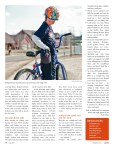
But don’t go buy any old helmet at the local garage sale. The U.S. government has created safety standards for them. A sticker should appear on the helmet saying it has met standards set by the Consumer Product Safety Commission (CPSC). The helmet should also fit properly (not be too big or too small). The helmet should sit level on your forehead. Kids might want to tip the helmet back so it doesn’t hug the forehead. I’ve even been guilty of this, as it doesn’t pull my hair as much….but if the forehead is showing, the helmet isn’t doing the job. And a reminder to little boys who love wearing their Twins baseball hats in the summer. NO wearing your hat under your bike helmet. The strap also should be adjusted so it’s snug under your chin. They shouldn’t be twisted or loose. If the straps are hanging to the sides of the helmet, the helmet is likely to fall of your child’s head when they need it most.

And if your child still whines about wearing the helmet, remind them that bike helmets are WAY cooler now than they were back in the 70’s and 80’s. Today’s helmets are lightweight and come in super cool colors for both girls and boys. My son loves to personalize his with his favorite Transformers stickers. Better yet, how about reflective stickers since they will make your child more visible to people driving cars.

Be Seen – Be Safe

Kids should be riding only during the day.  Their smaller bikes and bodies are harder for drivers to see. Some precautions that can be taken either in early morning hours or dusk can include bright clothes and reflectors. Bright clothes and reflectors of all kinds can be found in most stores. It’s important that other people on the road see your kids.

And avoid riding at night. If you must ride at night, wear reflectors on the front and rear of your bicycle.  Most states have laws requiring bicyclists to use lights and/or reflectors during nighttime hours. The laws do differ from state to state on how bright the lights need to be and where they are located.  (note: MN. Statute 169.222- requires front-facing white light visible from 500 feet; attacked to the bike or the rider; rear-facing red reflector; reflectors on each side of both pedals; 20 square inches of reflectors on each side of the bicycle. A red-flashing rear lamp is optional)

Also, make sure nothing is dangling while your child rides his or her bike. You don’t want things to get caught up in the bike chain, including loose pant legs, shoelaces or backpack straps. Kids shouldn’t wear sandals, or worse, flip flops when riding. NO bare feet, please. Take it from this author, who broke her leg by getting it caught in the bicycle spoke when she was 6…no dangling.

Rules of the Road- not just for cars

Bicycles are considered vehicles in many states, and have the same rights AND the same responsibilities to follow the rules of the road as motorists. Especially if your riding in a more populated area (a busy Minneapolis park), or riding on a busy city street versus a bike path. Kids should be aware of these basic rules, and be sure to follow them yourself if your all out on a family bike ride:

  • Go with the flow of traffic, not against it.
  • Obey all traffic laws, including stop signs, signals and lane markings
  • Attention kids-  watch out for those parked cars! Ride far enough out from the curb to avoid the unexpected, like the door opening suddenly, or the car pulling out.
  • Look before you turn. When turning right or left, always glance behind you for a break in the traffic, then signal before making the turn. Keep an eye out for left or right-turning traffic.
  • Keep an eye out for possible path or road hazards. Potholes, rocks, gravel, leaves and broken glass are everywhere. All these hazards can cause a wipe out.
  • Control your vehicle…or bike. ALWAYS ride with both hands on the handlebars. Older kids who ride frequently can graduate to just one hand, but never 0 hands! You might even suggest your child wear riding gloves, it will help them grip the handlebars better. And they’ll look like a professional. Cool.
  • Carry your books and other items in a bike carrier, or a backpack.
  • No crazy driving! Be predictable, not unpredictable. Ride in a straight line and not in and out of cars. Signal your move ahead of time.
  • And last but not least….no wearing headphones while riding the bike. Music can distract kids from the noises around them, such as a car honking its horn so they can get out of the way.

Armed with safety information, your kids will be able to enjoy the Minnesota biking season. Did I mention it’s short? Get out there and enjoy!

Suggested websites:

www.kidshealth.org

www.bicyclesafe.com

www.bicyclinginfo.org

www.livestrong.com

www.nhtsa.gov

www.mndnr.gov/trails

Too Much too Soon?

April-Cover Feature Story MN. Parent Magazine

Photographer: Cy Dodson (www.cydodson.com)

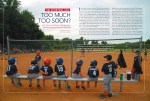
It was a perfect summer evening. The sun was just starting to set behind the trees framing the baseball diamond. All of the players were in their correct positions. All had their shirts tucked in. Hats straight. Red belts matching red socks. For a moment, if you squinted perhaps, you might think you were watching high school players — soon-to-be-men focused on the task at hand. But then the shortstop bends over and begins to draw a circle in the dirt. About the same time, the first baseman takes off his glove and begins tossing it into the air.

“No playing in the dirt! There’s someone at bat!” barks the coach, adding, “first baseman! That glove needs to be on your hand!” These were not upper level players. These were little boys — boys in first and second grade.

I smiled as the shortstop stood back up and got into his defensive stance, his eyes still focused on his unfinished artwork. Yes, the shortstop is my boy, and yes, he loves to play baseball. I didn’t cringe inwardly when my son told me a few years ago he wanted to play T-ball. I wasn’t sure of the time commitment, but I figured he was only a kindergartner, so it couldn’t be that extensive. I have noticed, though, after watching my son advance through T-ball and now coach-pitch baseball (a technique where players under nine years-old bat a baseball safely pitched to them by their own coach) — the time and price commitment only grows with the child and the choice of team play.

Molly Sproull’s son is involved in hockey in Lino Lakes. “It started, really, with his skating lessons. He skated for fun, just a Saturday morning type arrangement. He was probably three at the time.” Her boy is now eight, out of the Mite Program and into a more organized club. “Hockey is also triple the cost of soccer,” says Sproull, whose son also participates in summer soccer. “All of that equipment. We’ve taken advantage of skate leasing programs, and we’ve used Play It Again Sports to try to cut back a little bit. We’re cutting corners where we can.”

Minnesota offers an array of sports through the changing seasons. Between all of the community rec, school, and private club programs, the number is almost dizzying. While sports such as lacrosse and golf are increasing in popularity, the sports commanding the numbers are hockey and basketball in the winter, and baseball and soccer in the summer.

When a parent hears, “I want to play hockey” or “I want to try baseball” the first reaction is usually “Great! This could be a lot of fun,” followed with more pressing questions such as, “where do I sign my child up for this? How much will it cost? What is the time commitment? Will my son/daughter be good enough?”

According to the Sporting Goods Manufacturers Association (sgma.com), about 15 million children play baseball. This makes it the third-most popular sport, right after basketball and soccer. A smidge over 14 million kids play outdoor soccer; however, if you factor the indoor soccer participant numbers, it bumps ahead of baseball into second place. Basketball outpaces both of them, boasting 26.2 million youths six and older. In the Midwest, hockey also rules. After all, Minnesota has produced more U.S.-born professional hockey players than any other state.

which sport? when?

By late winter, baseball and soccer leagues and clubs are already organizing the teams and coaches, having meetings and getting uniforms ordered. Practice usually begins indoors in mid-March. Outdoor practice starts up when the fields are dry enough for play. Molly Sproull takes off her hockey mom cap then, and turns to soccer. “My son has played soccer since age four,” she says. “We started with indoor soccer, and he played March through the beginning of July. It’s relatively easy to pick up. The equipment is minimal at this level; there aren’t a lot of expensive things needed. That’s been a positive. We’re moving into traveling soccer this summer.”

Christie Cuttell, Cottage Grove, has two boys in baseball. “Summer baseball is easier on the whole family,” she explains, “there’s not as much going on, and it’s a lot easier getting to the venues. School is wrapping up; it’s just better financially.” She adds that she enjoys baseball more, since it’s outside. “With basketball and hockey, you are confined … holed up. I have friends who have kids in hockey, and they’re inside five months straight.”

Cathy Hults, Circle Pines, also enjoys her fourth grade son’s involvement in baseball. “When my son was little, we tried to get him into a few sports,” she explained. “He’s very active. He’s been in baseball forever.” She also added that the sport doesn’t require as much of a financial commitment, beyond registration fees and basic baseball gear.

Tony Grubbs, Ham Lake, has coached in the Centennial School Program for five years. He said both his kids showed interest in baseball at an early age. “I started [coaching] T-ball and worked my way up. I’ll be doing coach-pitch one more year. I have a good time, and I love doing it. Our draft begins earlier and earlier, however. I noticed our baseball league [also] offers more clinics in December and January.”

Grubbs says that while all parents want the best for their kids, he feels many parents judge success on simply winning the game. “I see success when the player gets better,” he stresses. “The player learned to throw the correct way — that is success. Yes, people want to see wins. But I love to see the kids do well and improve and understand the game.”

And there’s nothing wrong with keeping your child in a less competitive league. “The in-house league is nice for folks who don’t want [the time and cost commitment of a] traveling league,” says Grubbs. “You still get play experience. The traveling kids usually live and die their sport, however, and can be better players.” He said that traveling teams bump up the time commitment and financial levels. “With a traveling team, you might be practicing every night all week, with games on weekends,” he says.

Cathy Hults’ baseball-playing son also plays basketball in the winter. “This is his second year of basketball,” says Hults, who says this is considered a late start in basketball. “But he picked it up really fast. He’s a tall kid,” she added. She said she hasn’t noticed a big difference with the financial and time commitment with basketball, but that she and her husband are checking out the traveling basketball team for next winter. “Traveling basketball, I understand, is around $400.”

Coach Brent Cuttell, Cottage Grove, confirms. “Stay in-house for as long as you want, it’s much cheaper. If you go the traveling team route, it gets more expensive: tourneys, travel, and hotels. Financially, traveling teams are five times more expensive than in-house. [With] traveling, you probably pay $400 or more and in-house is only $80 to $100.”

All of the time commitment and financials on baseball, basketball, and soccer seem to pale in comparison to hockey.

Grubbs said he is learning about hockey firsthand through his younger son. “This is his first year,” says Grubbs. “It’s a lot more expensive. You can find used stuff pretty reasonable, but I about fell over when I saw the bill.” He added that the registration fees alone can be financially challenging.

Coach Cuttell, who attends several coaching clinics a year, including the Glazier Football Coaching Clinic in Minneapolis, said he has noticed a trend in Minnesota youth hockey. “Some communities you’ll have 800 kids playing, but in a matter of years you’ll only have 15 still playing. They burn out. They quit playing. In this state, there are summer hockey clinics, skate clinics, goalie clinics — they create a 12 month commitment … and soon you have the kid saying, ‘I don’t like it anymore.’”

Molly Sproull seconds the concerns regarding financial commitment, but chooses to look at some positives. “In hockey, at least in the age six and seven group, parent coaches are so enthusiastic. You don’t always get that in other sports. There are so many more time and money commitments, and the coaches are so willing and able to share their skills.” She adds that she has an older daughter, and worries about balancing her activities and schoolwork with her son’s hockey practices and games. “I worry also a little bit about him moving up into the upper grades, and going to practice a couple hours a night. He will have homework, too. Cramming it all in … it concerns me a bit.”

Barclay Kruse, chief communication officer at the National Sports Center in Blaine, said there are a lot of hockey programs available. “We run our own hockey programs, where parents can sign their kids up on teams,” he says. “Though in the world of youth hockey, the community-based club is king.” He added that most folks don’t know that some of the biggest hockey tourneys are in June and July. “We run an event for seven weekends … different age groups on different weekends. We keep ice in six of our seven sheets, all the way through the summer. There’s enough demand in the summer for that.”

This slideshow requires JavaScript.

too young?

Finally, the most pressing issue of all: are we starting our kids too young? Like it or not, all of the parents and coaches interviewed for this article said they believe children are being introduced to sports at younger and younger ages, and that’s not necessarily a good thing.

“I think it’s ridiculous,” says Coach Cuttell, “when kids are starting at three and four and five years old. I think if we begin putting goals [in place] for what measures a success or not in a specific arena … it’s a lot of pressure.”

Yet, all the parents and coaches agreed on one thing. If kids don’t start young, they are “behind” by the time they hit fourth and fifth grade. “It’s only going to get worse,” says Grubbs. “I don’t think I’m fine with starting kids so young. My older son, in fourth grade, wanted to try hockey. [With his inexperience] he’d stick out like a sore thumb, and I don’t want him to go through that. It’s hard to say no. But if you’re in fifth or sixth grade, you’re behind already. It has become so specific. This is your sport, all year around. Coaches want kids to know what they’re doing, and who know how to play. My younger son is the oldest player on his team and he’s in second grade!”

Says Sproull, “I think it’s a little disappointing that if you don’t start them young — and they would like to do another sport later — they’re going to be at a disadvantage. It’s part of a life lesson, I suppose. It’s sad that that’s the reality now.”

Coach Cuttell sums it up with one of his favorite Cal Ripken Jr. stories. “When asked how many little league games Cal Ripken Jr. played every summer as a kid, do you know what he said? Eight. That’s all he played each year. Then I got to thinking about how much I played when I was a kid. Maybe 10. They have kids playing 40 to 50 games a summer now. Same age. What I think is wrong: when a kid plays too many games … the games don’t mean anything. It’s just another game or tourney. When you only have eight games a year, they mean a lot. Kids want to be kids. They want to go in the yard and kick the ball around. We’ve created such a game environment for young kids, that they don’t know how to play pick up games anymore. They can’t play without an official or umpire. Kids these days think they have to document the game. You just don’t see kids playing pick up anymore. ‘Oh, we don’t have nine players? I guess we can’t play.’ That’s sad.”

“Whatever the season,” Christie Cuttell adds, “sports teach about socialization, camaraderie, teamwork, taking direction from authoritative figures — and that’s a good thing. Just don’t let it become too much.”

[sidebar]

Resources

Lance Armstrong Foundation

livestrong.com

Definitive daily health, fitness, and lifestyle destination website

Sports Illustrated

sikids.com

The online counterpart to Sports Illustrated For Kids magazine. The goal of the site is to create a fun, safe environment for kids, filled with some of the best news, games, and interactive features on the internet.

American Library Association

Ala.org

Offers a list of excellent sports websites that are appropriate for children. Websites cover all sports, including Judo and running. They do the research for you/list the website with a “Pencil” rating system so parents know it’s appropriate for: PreK, Elementary, Middle School, and Parent/Teacher.

Kidsites

kidsites.com

Touts itself as the leading guide to the best in kids’ websites, offering have a sports section full of sports trivia and information.

Super Camping for Super Kids -MN. Parent (March issue)

Asthma Camp Article

MN. Parent-March Issue

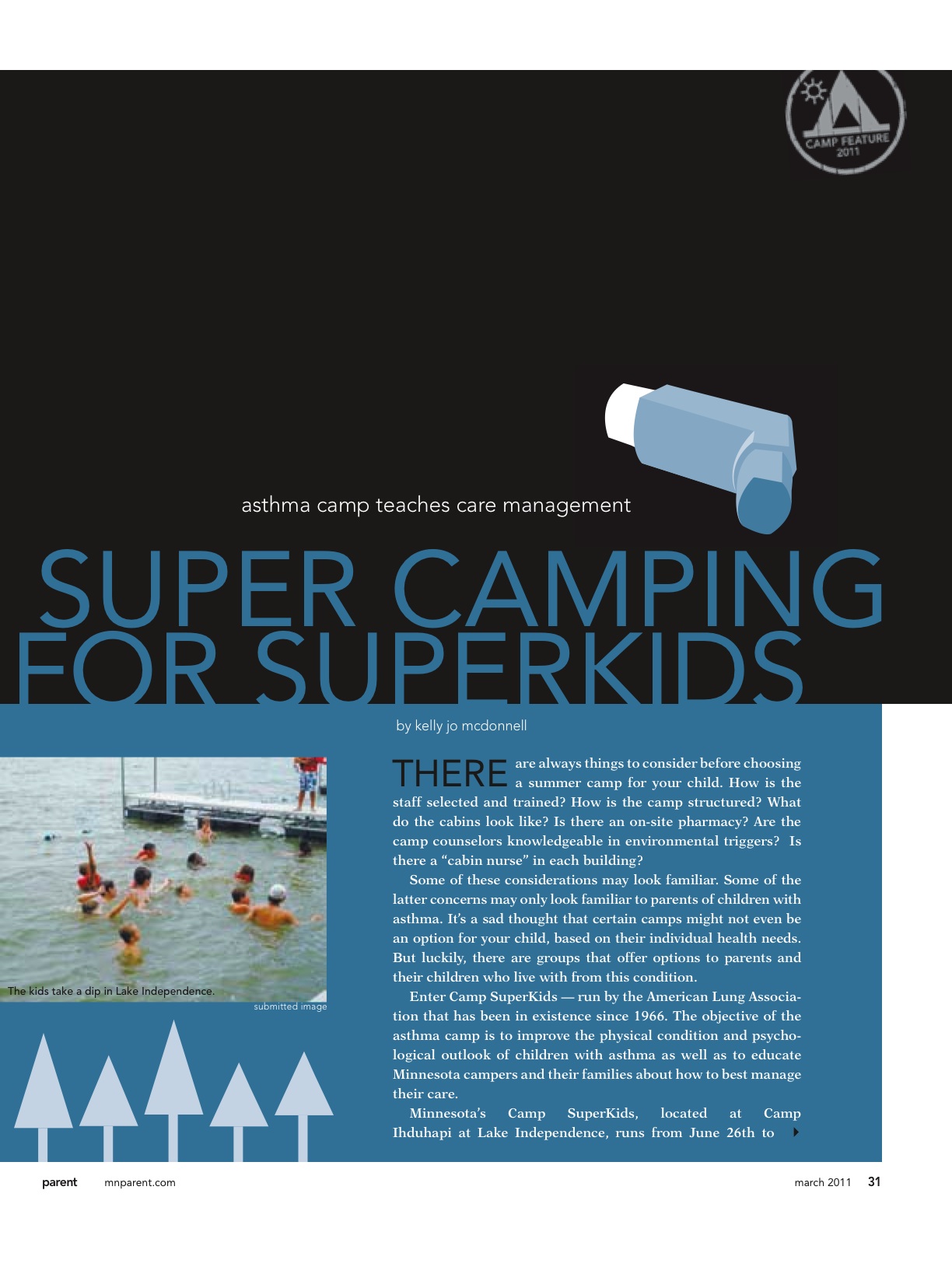
There are several items to consider before choosing a summer camp for your child. How is the staff selected and trained? How is the camp structured? What do the cabins look like? Is there an on-site pharmacy on site? Are the camp counselors knowledgeable in environment triggers?  Is there a “cabin nurse” in my child’s cabin?

Some of the concerns may look familiar. Some of the latter concerns only look familiar to parents of children with asthma. If your child suffers from asthma, the list of concerns is a long one. Some Summer Camps might not be an option for your child. But luckily, there are groups such as the American Lung Association that are offering options to parents and their children who suffer from these conditions.

Enter Camp SuperKids – a camp run by the American Lung Association that has been in existence since 1966.  The objective of the asthma camp is to improve physical condition and psychological outlook of children with asthma as well as to educate Minnesota campers and their families about how to best manage their care.

Minnesota’s Camp Superkids, located at Camp Ihduhapi at Lake Independence, runs from June 26th to July 1st in 2011. The kids that come to this camp have moderate to persistent asthma, meaning the children need a daily controller medication. If the child has very severe asthma (ie: been to the emergency room in the last month of the camp), the Camp recommends the child sit the camp out, and will help the child get ready for the next year.

While this camp has the same fun outdoor activities as other camps do, it offers something a little bit more. Peace of mind for the asthmatic child and his or her family.

“We provide all the camp experiences,” explained Cynthia Peat, Director of Camp Superkids and Manager of respiratory health at the American Lung Association in Minnesota, “they still get to go swimming and canoeing and hiking and zip line. They participate just as any other YMCA camper would.”  While these normal summer activities are a staple for a summer camp experience, they also can be “triggers”. Mother Nature has her share of triggers for the asthmatic child, including pine, grass, pollen, ragweed and more.  The great outdoor experience can turn into the great emergency room experience in a very short time. But at Camp Superkids, all camp counselors are aware and ready.   “That (triggers) is a huge concern,” said Peat, “our goal at the end of the camp is for the kids to recognize and understand that they have to take good care of themselves, and to know what to do around their triggers, so they understand. A lot of kids who has asthma don’t go as fast, or develop as quickly, and parents will shelter the kids from a lot of things. The bigger goal of the camp is to tell kids that they can! Just take precautions”.

The precautions are subtle, but straight forward. Some examples are:

  • There’s a “cabin nurse” assigned to each cabin.
  • Kids check their meds into the nurse. Meds are distributed twice a day
  • There’s an on-site pharmacy, and an on-site doctor 24 hours a day
  • For every 8 campers, there’s one medical staff at all times

At Camp Super kids, the camp counselors are not only specially trained in asthma, most are sufferers themselves.  Joey Cuttoo, Camp Manager, started at Camp Super Kids when he was 7 years old, and suffered from persistent asthma. Cuttoo attended all the way up until he was involved in the Jr. Leaders Program for teens. He now manages the entire camp, and helps with the training of camp counselors. “We work closely with Joey Cuttoo,” explained Peat, “there’s a training program the couple weeks of May, one of our doctors do the run-down. They have a good baseline, then there’s a Sunday review session before capers arrive. There’s a counselor for every cabin of 8 to 10 kids”.

Peat said the children absolutely love taking part in the camp experience. “They go swimming, they zip line, there’s bonfires with camp songs, hiking, there’s a climbing wall, and one night they got to go on a camp out on an Island,” said Peat, adding that there’s a physician on every boat, and a tackle box of emergency supplies along for the trip.

While the kids may only be interested in the fun, outdoor activities, Camp Superkids also offers a little bit of education for their campers. After Dinner the campers will get some Asthma education in the form of games. An example is “Lung-Go” which is like Bingo, except you have to answer questions that are asthma related.  The campers learn what asthma is, how asthma attacks start, how they can avoided, and how asthma can be better managed in the future.

While children of all ages can suffer from asthma, the American Lung Association recommends children ages 7 to 15 attend Camp Superkids. (and 15 and beyond can be involved in the Jr. Leaders program at the the camp) The camp does target the entire state of Minnesota. About 1/3 of its campers come from the inner city, another 1/13 from suburbs and the rest come from greater Minnesota. 80% of the campers receive ‘camperships’, which are offered to low income families. Most of these families often lack the resources or don’t have health insurance to visit the Doctor’s office for their children’s asthma. “We want to make sure we won’t turn away any child who wants to come,” explained Peat.

Camp Superkids can be a challenging camp to run, and Peat sites the coordination of the medical staff is the biggest challenge as well as its highest priority. “We have a medical board, and everyone is on the same page,” said Peat, “we coordinate enough volunteers to help staff the medical part of the camp.” She added, for example, that pharmacy students from the Children’s Hospital volunteer their time in the service center and pharmacy, and nurses, allergists, pediatricians, and respiratory experts volunteer their time a well, with the majority of them coming from the Mayo clinic in Rochester, MN.

Above all, Camp Superkids is fun, and their campers learn that they’re not alone with their asthma and that there are kids out there just like them.  Peat said that the greatest reward for running the camp is the fabulous stories she hears from both the children and the parents. “The kid returns from camp a different person…really being able to take indpendent care of themselves. It’s the best to hear! I’ve already been getting calls on when the camp is this year”.

Registration for Camp Superkids begins February 1st.  For more information go to www.lungmn.org (once on the main page, go to “Programs”, and then “Asthma Camp”)

Price – $495 for 5 nights

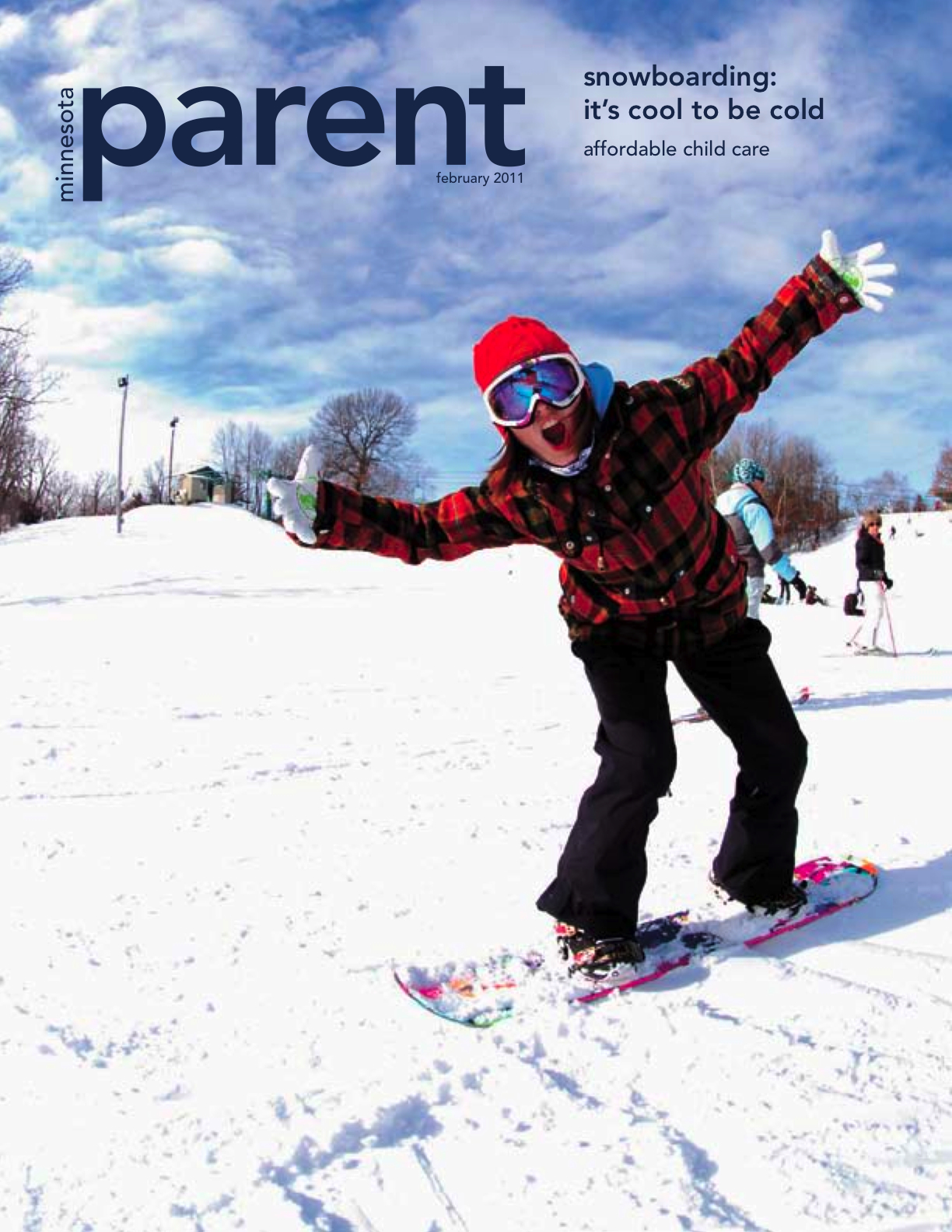
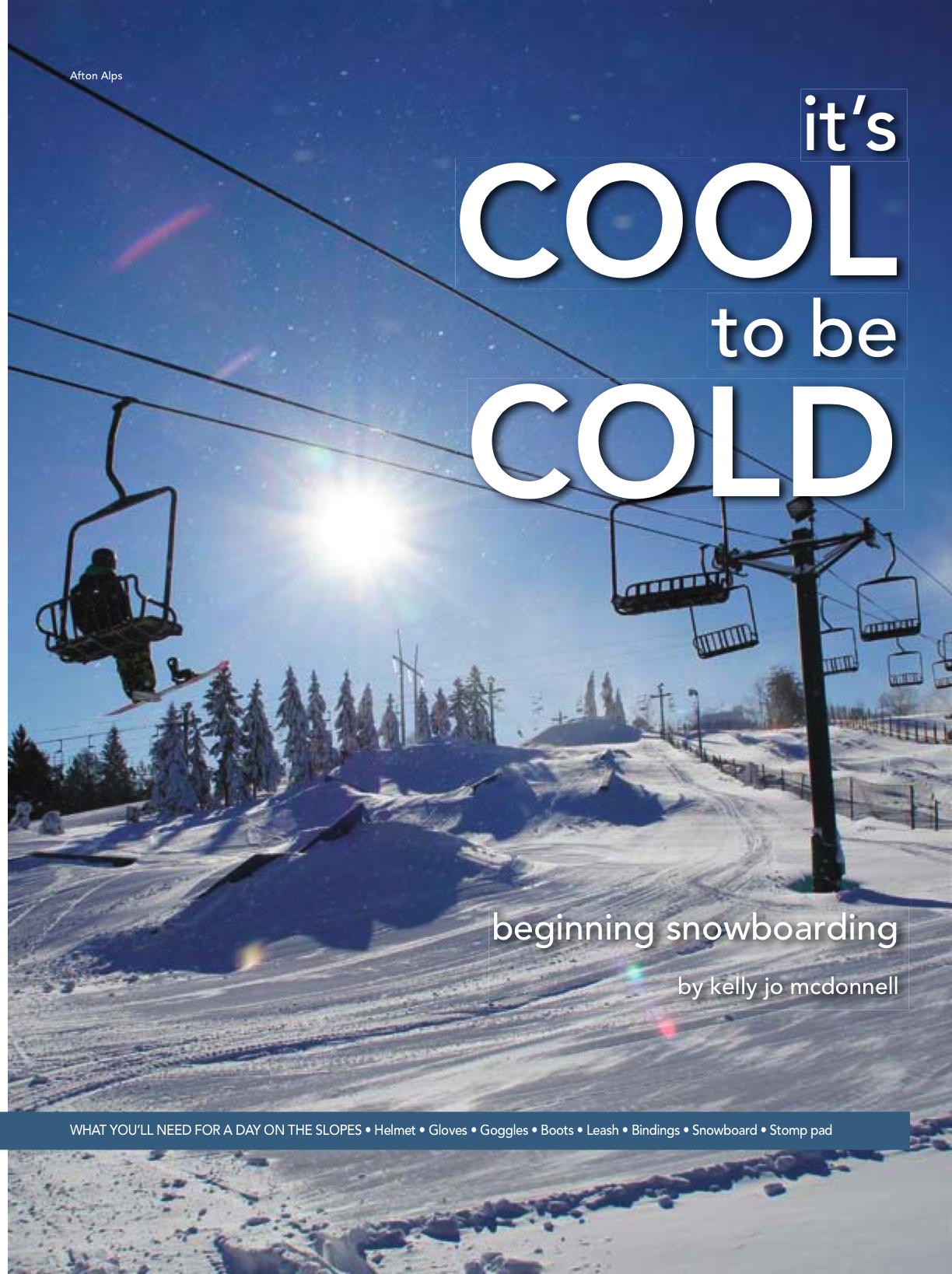
It’s Cool to be Cold (MN. Parent Magazine-March Issue)

Beginning Snowboarding

It’s 20 degrees outside on a sunny Saturday afternoon — where do you want to be? Under a blanket reading a book, while your kids play Wii? That seems about right, doesn’t it. When temperatures drop, families stay inside. The lure of the out-of-doors better be pretty good to get kids bundled and families out for a full day of brisk weather.
While there are numerous winter sports (skiing, sledding, snowshoeing) to tempt anyone away from a blanket or television set, snowboarding is at a peak in popularity. Just look around any of the area’s resorts and you will see countless skiers; but pay attention and you’ll notice just as many snowboarders.
It’s believed the first snowboard was developed in 196 5, when Sherman Poppen made the “Snurfer” (a contraction of the words snow and surf) by bolting two skis together — as a gift for his daughter on Christmas Day. But it wasn’t until the mid-1990s that folks starting seeing snowboarding in a new light, when it was added to the 1998 Winter Olympics in Nagano, Japan. Now, ask any young kid whom Shaun White is … you’ll get an immediate and informed answer.
learning the slopes
These days, snowboarding is the ultimate cool. And my son, Hayden, even at age eight, is well aware of the sport. While he has enjoyed other winter activities (sledding, tubing), he wanted to learn how to snowboard.
Enter Mike Chenoweth and Chad Hoag, snowboard instructors at Trollhaugen Ski Resort, right across the border in Dresser, WI. Trollhaugen has customized weekend programs for kids: “Little Trolls” (for ages four to five) and “Trolls” (skiers age six to 12 and boarders ages seven to 12). Regular lessons are available seven days
a week.
This place is super-handy, as families can rent everything they need on site, and have a coach/instructor help along the way. Hoag immediately put Hayden at ease, explaining he was going to set him up with his snowboard and other necessary gear for the day. As we walked to the rental area, we passed the ski shop and Hayden eyeballed the colorful snowboards. I was eyeballing the price tags. A “Ripper” snowboard was on sale for $199.95 instead of $229.95. “It’s on sale!” said Hayden.
Hoag steered us away from the shop, explaining that his charge would be starting with a trainer snowboard, which as it turns out is quite a bit heavier than the average snowboard, and much less colorful. &ldqu o;Can you wiggle your toes?” he asked Hayden, as he was putting on his boarding boots.
Hoag explained that age eight or nine is a great age to learn skiing or snowboarding. “This year we’ve started a program for younger kids, four and five and six,” he explained, “but the expectations are a little bit different at that age. They don’t have all the fine motor skills.” He added that children of Hayden’s age might have trouble with being “squared up” on the board and not “sitting in the back seat.” He explained that with skiers, the torso, chest, and head primarily face down hill as they ride. For snowboarders, they slide sideways down the hill, so they need to remember to keep the torso and chest parallel to the snowboard and turn just the head to look in the direction of travel. “‘Sitting in the back seat’ is a term used when snowboard riders put more wei ght on their back foot instead of their front/lead foot,” explained Hoag. “It is usually associated with a fear of going down the hill; so new riders will have a tendency to lean backward on their board.”  The sooner a new rider can learn to keep slightly more weight on their front foot, the quicker they will progress with their riding.
Once my son was all laced up, he followed Hoag to the practice slopes, talking excitedly about snowboarding. “It’s just the pure joy of ‘surfing’ down the hill and enjoying the outdoors,” Hoag told me. He locked in one of Hayden’s little feet on the board, and began running through basics, such as how to walk along with the board, and most importantly, how to fall correctly. They first practiced falling forward. “Not on your elbows,” reminded the instructor, stressing it’s best to fall forward on the knees and forearms when moving in that inevitable direction. Falling backward came a little easier for Hayden. “Fall on one cheek or the other,” said Hoag, “and don’t hit your tail bone.”
Once falling was mastered, the two worked on maneuvering the snowboard, which is much more difficult than it appears to be — especially for a 50 pound, eight year-old. While Hayden worked on this new skill, several young kids “hopped” past him, snowboards locked on both feet, trying to get to the tow rope. One determined boy simply fell to his knees and crawled to the rope, not wanting to unlock his feet to maneuver correctly. Hoag kept Hayden grounded, reminding him, “We’re going to be safe first, we’re going to have fun, and along the line we’re going to learn something.”
balancing act
Once my son could get around, he next worked on standing on the board correctly, which initially seemed to be quite a balancing act. Grabbing the rope to go up the test hill was another feat in itself, but he held on for dear life as his coach shadowed him all the way up. Once on the top, Hoag again ran him through the “falling” rules. And it was a good thing, as on the first trip down my son made it halfway, and then fell quite spectacularly. “Good job!” said Hoag, who was right behind him. This went on for about an hour, until Hayden slowly worked his way down the hill without a tumble. He even made it through the “hoop” at the bottom (a hula-hoop type of arc at the bottom that skiers and snowboarders try to pass through).
It was about 20 degrees that day, so at the end of the two-hour lesson, we congregated at the Kids Lodge (also known as The Learning Center) to warm up with hot cocoa. Mike Chenoweth (the supervisor and lead clinician), checked in, and he and Hoag discussed how the lesson went. Their enthusiasm for snowboarding and Trollhaugen is infectious, and both are excited about the Learning Center Program. “This is not just for kids,” said Chenoweth, who began snowboarding in 1988. “What we see is too much inactivity. Folks bring their kids out here; they’re enjoying winter. Mom and Dad — let’s enjoy winter with them.” Coach Hoag said that he and the other instructors all want snowboarding to be a sport the whole family can enjoy. My son asked him when he could go down the big hill. “Next time, buddy,” Hoag said.
On the way out, we booked Hayden’s next snowboarding lesson. Who knows, the 2020 Olympics aren’t that far away.
Kelly Jo McDonnell is a writer based in the Twin Cities.

Where to board
Every slope will have something different, so be sure to check websites or call for more information.
Afton Alps
6600 South Peller Ave.
Hastings, MN 55033
800-328-1328
Buck Hill
15400 Buck Hill Rd.
Burnsville, MN 55306
952-435-7174
Hyland Ski and Snowboard Area
8800 Chalet Rd.
Bloomington, MN 55438
763-694-7800
Lutsen Mountains
P.O. Box 129
Lutsen, MN 55612
218-406-1320
Mount Kato
20461 Highway 66
Mankato, MN 56001
507-625-3363
Trollhaugen
2232 100th Avenue
Dresser, WI 54009
715-755-2955
Welch Village
26685 County Road 7 Blvd.
Welch, MN 55089
651-222-7079
Wild Mountain
37200 Wild Mountain Rd.
Taylors Falls, MN 55084
651-465-6315
What you’ll need for a day on the slopes
• Helmet
• Gloves
• Goggles
• Boots
• Leash
• Bindings
• Snowboard

• Stomp pad

Time to Ice Fish

Kids & Ice & Fish?

It’s cold outside.  But we Minnesotan’s have plenty to keep us busy. We have 10,000 lakes (now ice) and they are full of fish. How about combining the two for some family ice fishing? Not sure where to start?

It’s not as hard as you think. Here are some hard and fast pointers on making it happen:

  • Getting Started: get a guide (and/or a seasoned Grandpa, Uncle or friend)

Especially if this is the family’s first time out, a fishing guide is worth his/her weight in gold (and fishing gear). And it’s much more economical that one would think. A fishing guide will take care of a whole list of fishing gear families may not have thought about, including:

–       Ice fishing house –  (guides will usually have permanent ones that will keep the wind and cold at bay, and perhaps even have a little heater inside) If not, sitting on a bucket on the ice works well enough, too.

–       Rods – The guide will use a short rod if your in an ice house; they let the fisherman sit closer to the ice hole, and they also let the fisherman set the hook easier. Longer rods can be used if you’re sitting on a bucket out on the ice. (Home Depot has nice 5 gallon buckets for cheap that can be used to carry your gear, then to sit on)

–       Ice Drill – This is for cutting through the ice to fish, and it also helps to have a slush remover to clean out the ice hole. Remember: four inches of ice and deeper for walking on the ice, 6 inches for an ATV, 12 inches for a car or pick up.

–        Forceps/needle nose pliers – your guide will use these to help you with hook removal

–       Bait – should be kept on the small side, and include minnows, crawlers or small moth larvae (otherwise known as waxies) but your guide will have all the bait on hand already. The guide will also have ice-fishing lures on hand as well.

–        Know your fish: the guide will also act as a teacher of sorts, and be able to help out with fish identification. Did your son just catch a perch? Or your daughter a walleye? Might be fun to get a Fish ID book to bring along (one that can be read with mittens on)

Safety. Clothes and Manners

–       Know where you are on the ice, and set boundaries. (ie: look for holes in the ice) Although your guide will know, it helps for everyone to know the area-carry a phone, compass, map or GPS unit. The guide will have your locations mapped out for you, and will know the best “honey holes” to fish. Ice Fishing takes place on ponds and lakes of all sizes, with safe ice of course. Larger water bodies will provide more of a diverse fishing opportunity for your kids. Most state-owned lakes do allow ice fishing, while county or municipally owned waters may prohibit it.

–       Keeping your feet warm and dry will be the first priority-get the kids (and yourself) heavy, felt-lined boots and wear thick, wool socks. Maybe tuck an extra pair along just in case of cold, little toes. Stocking caps are a must, try a knitted or fleecy hat that covers ALL the ear. A scarf or muffler helps, as well. For gloves or mittens, remember that mittens tend to trap more warmth than gloves, so find some mittens that are thick. Layer up thin gloves underneath the mittens for some extra warmth. This also works well when the kids have to take off the mittens to either tie a knot, or take a fish off the hook.

–       Manners aren’t just for the table. The fishing guide can be helpful with etiquette, but some rules of the road include: don’t set up too close to another fisherman unless you ask first, keep your fish in a bucket with some water and slush or release them before they freeze; don’t blast your radio or litter; and the big one: Do not make a lot of noise, it can spook the fish!

This is Fun Remember….

Keep in mind these are kids that are fishing. Keep the sessions short, 4 hours max.  Plan a big lunch for a slow bite day, maybe even bring a grill and have a hot dog cookout on the ice! Some other tricks for kids include having them use a hand auger and let them try making the hole; be sure to pack some warm, sweet liquids like hot chocolate; try out a underwater camera (like the AquaVue) to get a real view of what’s happening underneath the ice.

If families are interested in more group events, check out the Minnesota DNR’s website at www.dnr.state.mn.us/events and/or www.dnr.state.mn.us/minnaqua/icefishing for a complete calendar listing of winter ice fishing events, including Winter Trout Fishing, Ice Fishing 101, Fishing Derbies, and Take a kid ice fishing clinics. For ice safety, check out www.dnr.state.mn.us/safety