MN. Parent Magazine-Sept. Issue – Weekend hikes, near and far!

DSC_0326

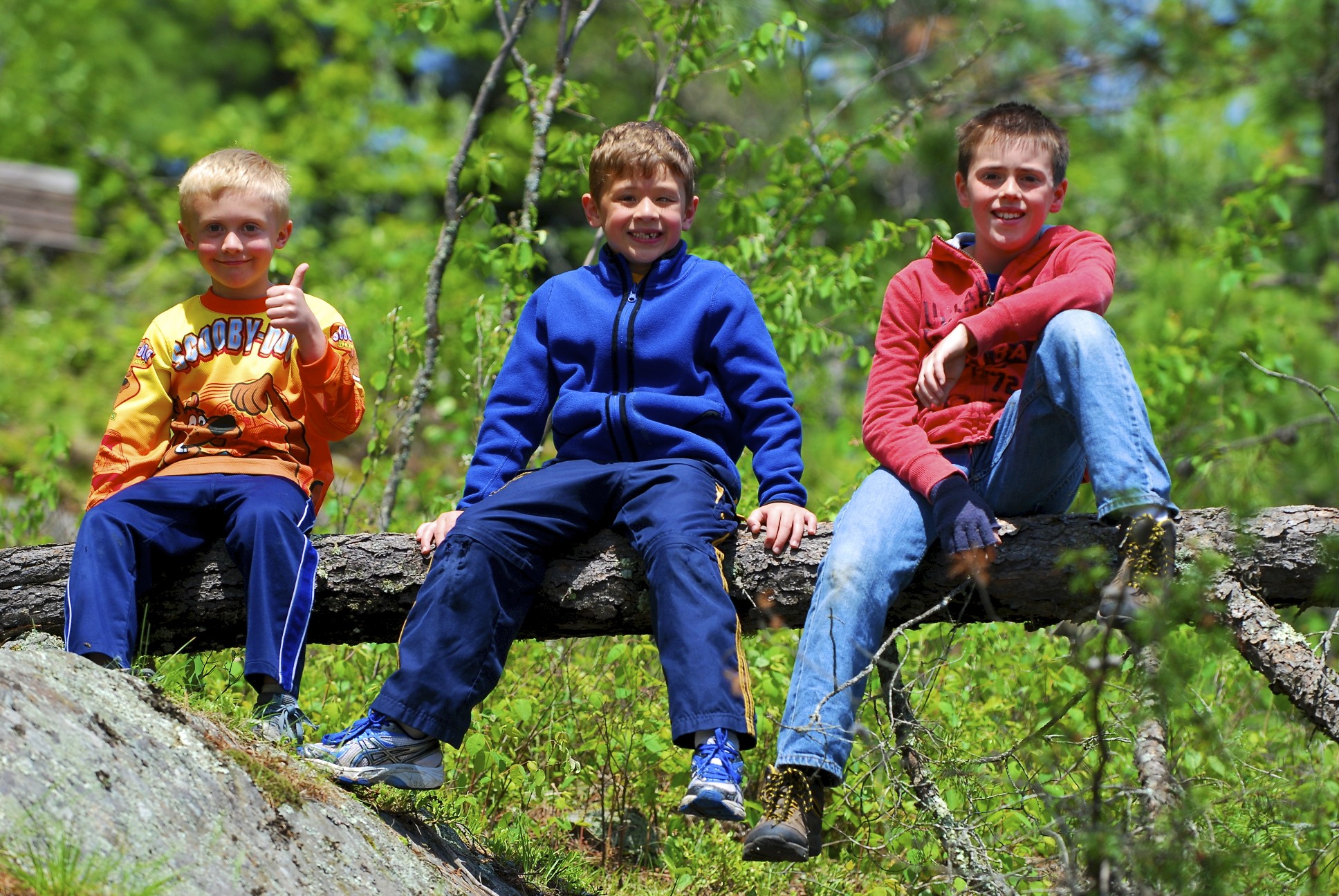
Hiking with kids is a great way to keep them connected to the outdoors, but it can be challenging for the parent planner. Take our advice: don’t choose anything too long or strenuous for your first couple of outings. For kids, the hike is about adventure. Pick a trail that has some features, whether it’s a waterfall, cliffs, or a stream. It gives them a goal to reach. Kids are natural explorers, so plan plenty of time for it—you’ll be traveling at the child’s pace. Making the hike fun is key to success. Oh, and pack lots of snacks. 

Choosing your hike

Choosing a destination can be the trickiest part of the whole process. Luckily, we Minnesota parents are sitting on a gold mine of parks and forests. Minnesota has a wonderfully diverse state park system: over 227,000 acres in 73 parks and recreation areas. (That comes down to 1,030 miles of hiking trails.) The trick for us is narrowing it down. 

“Each Minnesota park has unique characteristics,” explains Kaija Helmetag, information officer with the Minnesota State Park and Trails, “and all of them have great hiking and, for the most part, have family friendly trails.” 

She suggests checking out park websites first. “All have links to PDFs with maps, so you can see the trails, the trail mileages—it’s a great resource. There are also blurbs at the beginning of each page that give you an overview of the park, as well as its natural and cultural history. You can get a quick snapshot of what the park is all about.” 

For beginning hikers, keep it simple and close to home. Here are just a few of the gems: 

Fort Snelling State Park 

Location: West St. Paul

Nice touch: The historical aspects of this park make it a good day trip for many reasons: after hiking, you can explore the fort, which dates back to 1820. There is also excellent birdwatching due to its proximity to the Minnesota Valley National Wildlife Refuge.

The trails link to Minnehaha Park and the Minnesota Valley National Wildlife Refuge. The summer hiking trail is 18 miles long, and is easy to moderate. It offers an array of things to look at, which with kids’ ever changing attention spans, is perfect. (I’d suggest just doing part of it.) The trails lead through wooded areas, but also along rivers and lakes. Pack a lunch and use one of the sheltered picnic tables near the visitor center, then go inside for the interpretive exhibits (and a bathroom break) afterward. 

Interstate State Park 

Location: Taylors Falls

Nice touch: Glacial potholes (the world’s deepest) and a waterfall! Bonus: watch for rock climbers on the cliffs that line some of the trails.

An easy walk to the water will reveal paddleboats and kayakers. There’s the self-guided Sandstone Bluffs Trail (one mile), and the River Trail is two miles. The four-mile hiking trail is more rugged, with countless steps. Skip that one for now. There’s commercial and individual rock climbing permits offered at Interstate, and kids have fun watching the experienced climbers scale the boulders. This park has naturalists galore, and in September and October activities include prepping for a fall hike, Autumn Adventure Scavenger Hunt, and Leaf Art—all with their on-staff naturalists. 

“All of our state parks have tons of free interpretive programs that are aimed at families,” reminds Helmetag, “So if you are in the park and plan in advance, you can attend all kinds of naturalist-led activities.” 

William O’Brien State Park

Location: Marine on St. Croix

Nice touch: It’s along the banks of the St. Croix River and is a migratory pathway as well.

There’s a self-guided wheelchair accessible trail that begins at the picnic grounds (Riverside Trail) that is about 1.5 miles, dotted with interpretive signs. The other trail, 12 miles, ranges from easy to difficult at times, as it winds through wooded areas as well as wetlands. Dogs are permitted, as long as they are on a short leash. There are also a variety of programs offered year-round, such as a Voyageur Encampment Weekend the end of September, and Starlight Starbright and Geocaching101 activities (October).  

Lake Maria State Park

Location: Monticello

Nice touch: It’s a good place to see the “Big Woods”—maples, oaks, and basswood forests—one of the few remaining ‘stands’ of trees.

The hiking trail is 14 miles in length, and winds through wooded and rolling terrain. The fall colors are magnificent. There are two self-guided trails—Zumbrunnen and Forest Shadow—each is one mile each in length, and feature signs, a boardwalk, and observation points. One more thing: 2013 marks the 50-year anniversary of this park, so watch for anniversary events and special drawings throughout the year.

Afton State Park

Location: Hastings

Nice touch: Afton doesn’t disappoint with the scenery, as it offers prairies, deep ravines, and bluffs that overlook the St. Croix River. 

There’s a 20-mile hiking trail; however, there are shorter choices, such as the .75-mile self-guided tour that begins at the visitor’s center or the four mile paved bike trail. Afton is about 40 minutes from downtown Minneapolis, so close enough to be handy, but far enough away that your family will still have that ‘in the middle of nowhere’ feeling. 

Bunker Hills Regional Park

Location: Andover

Nice touch: After you’ve made the kids hike, there are plenty of other options for entertainment, including swimming and water slides, and horseback riding.

Miles upon miles of paved, limestone aggregate, and natural surface trails are offered in a large loop, with additional trails shooting off the main area for an additional easy workout. They are multi-use trails, so walk, bike, or rollerblade to your heart’s content on this 2.5-mile beauty with stretches of sun, coupled with shade from the impressive oak stands.

The North Country Trail

Location: Thomson, about 10 miles southwest of Duluth

Nice touch: Considered one of the best-kept “secret” trails, it wanders 4,600 miles and stretches across seven states!

The goal is not to hike the whole thing, of course, but sections of this trail are great for families. The trail enters Minnesota near Jay Cooke State Park, where the Superior Hiking Trail begins. You can choose the area and the scenery, as this path really offers it all. Even the City of Duluth’s leisurely lake walk is part of this trail!

RULES AND REGULATIONS REMINDER: 

Year-round state park permits are $25, and one-day permits are $5. The year-round permit provides unlimited access to all 76 Minnesota state parks for a full year from the month you purchase it. (And if you needed more incentive, by purchasing the permit, you help maintain and improve the programs at the state parks.) You can get the permits from the DNR, the MN DNR License Center, or at any of the state parks, which have self-serve kiosks or front offices. Note that regional parks will have separate fees.

 10 THINGS TO BRING

(Besides your kid, and your patience!)

  1. Water bottle (.5l-.75l). Something small to carry and to keep hydrated. Keep them drinking water to prevent heat exhaustion, which can occur even in the balmy days of fall. 

2. Hiking shoe. It doesn’t have to be latest and greatest, but something that can grip in loose dirt and mud will keep the trail walks going.

3. No cotton clothing. When cotton gets wet it stays wet and nothing ends a trip faster than a cranky kid. Synthetic shirts and pants dry fast and protect even when wet.

4. Backpack. Something your kid can load some of his or her own stuff into (i.e., snack and water, plus a treasure found on the path) to contribute to the family trip.

5. Sunscreen. When you are out for a day/weekend a sunburn makes it harder to enjoy. 

6. Hat (brimmed or baseball). Something for a little more sun protection.

7. Rain gear. Conditions can change quickly and being prepared will keep everyone calm and happy.

8. Snacks. A simple granola bar or even a Clif for Kids snack will keep the youngsters fueled for the next leg of the trek.

9. Magnifying glass. Something to explore leaves and bugs with.

10. Bug net. Find butterflies and fire flies and get a closer look by catching and releasing.

Alt 1. Walking stick. If they are tired or need a little more leverage on an incline/decline a collapsible walking stick will keep the trek moving forward to the next spot. 

Alt 2: Binoculars. Best way to see birds and other critters up close.

 — Andrew Clarke, Sports Manager at Joe’s Sporting Goods, St. Paul

Top of Form


Go wild

Go wild

July 1, 2013-MN. Parent Magazine
By: Kelly Jo Mcdonnell
Reconnecting your kids with nature

My son has a fort. It’s wedged between two evergreens in our backyard, and houses such treasures as slabs of wood and other knick-knacks. An old green army tarp hung by bungee cords serves as a wall. And while I sometimes sigh loudly at the amount of items that find their way into my son’s fort, I leave it alone. A few years ago my father told me that a boy’s fort in nature is his sanctuary and refuge. “Treat it as such,” he warned.

I would never argue that point, as my own childhood memories are steeped in the great outdoors. Many of the most cherished recollections I have involve either a vacation up north or my own fort nestled in a thicket. I want my son to have those memories, too, but I worry the experience won’t be the same. And I’m not the only parent thinking this. There is a growing disconnect between our kids and nature.

According to Richard Louv, author of Last Child in the Woods and The Nature Principle, it’s a phenomenon—and not a good one. It was Louv who first came up with the term, “Nature deficit disorder” when his Last Child in the Woods book came out in 2005. His hypothesis is basically that people, especially children, are spending less time outdoors.

Why is this happening? The reasons are myriad, and a few, obvious. One I can relate to is “stranger danger,” or as Louv calls it in his book, the Bogeyman syndrome. “Fear is the most potent force that prevents parents from allowing their children the freedom they themselves enjoyed when they were young,” he explains. “Fear is the emotion that separates a developing child from the full, essential benefits of nature. Fear of traffic, of crime, of stranger-danger—and of nature itself.”

My boundaries growing up included the entire town. Admittedly, my son’s boundaries are tighter. In a 2002 survey by TNS Intersearch for American Demographics magazine, 56 percent of parents in the U.S. said that by the time they were 10 years old they were allowed to walk or bike to school, but only 36 percent of those same parents said their own children should be allowed to do the same.

Restricted access

The loss of wild surroundings is another factor. In more and more cities and suburban neighborhoods, it can be tough to find green. But it’s worth looking for: a team study by researchers in Sweden, Australia, and the U.S. found that when children played in an environment dominated by play structures rather than natural elements, the kids established social hierarchy through physical competence. But by offering a grassy area with a few shrubs, and the kids engaged in more fantasy-style play, and their social standing became based less on physical abilities and more on language and creative skills. And a bonus: open play also provided greater opportunities for boys and girls to play together in egalitarian ways.

Even if you find a park or nature preserve, kids are seeing more restricted access. “Do not walk off the trail” one sign recently warned me at a neighborhood park. Everyone understands that the natural environment must be protected, but Louv questions the cost of that protection in some instances, and the direct impact it has on a child’s relationship with nature. Even environmentalists and educators, he points out, say, “look but don’t touch.” But sometimes that’s the only way to learn, especially for kids.

And a third obvious cause, of course, is the increased draw to spend time inside looking at screens, including computer, video, and television. The average American child spends 44 hours a week with some form of electronic media.

The effects of this are sobering. Our kids have a limited respect for their natural surroundings. Louv points out that this will be an even bigger problem down the road. “An increasing pace in the last three decades, approximately, of a rapid disengagement between children and direct experiences in nature…has profound implications, not only for the health of future generations but for the health of the Earth itself.”

Then and now

Research has shown that people who care about the earth now spent time in the natural world as children. GreenHeart Education stresses that we owe it to our children to give them unmediated time in nature, so that, as one native elder explained, “the land will remember them.” That is, they will feel grounded and have a sense of “home” that they care about.

Another impact of nature deficit may be the development of attention disorders. Louv suggests that going outside and being in the quiet and calm can help kids. “It’s a problem because kids who don’t get nature-time seem more prone to anxiety, depression, and attention-deficit problems.” As a mother of an ADHD son, this research is worth watching. Some tips include encouraging your child to play in outdoor green spaces, study or play in rooms with views of nature, or plant and care for gardens and trees at your place of residence. Louv explains that although the impact of nature experiences on attention disorders and on wider aspects of child health is in its infancy and easily challenged, it’s not to be brushed over. “Yes, more research is needed, but we do not have to wait for it. If, as a growing body of evidence recommends, contact with nature is as important to children as good nutrition and adequate sleep, then current trends in children’s access to nature need to be addressed.”

Childhood obesity is another issue, and about nine million children ranging in age from six to 11 are overweight or obese, according to The Institute of Medicine. It’s time for kids to move more, which means getting off the couch and heading outside and away from screen-time. Blogger Marc Bekoff of Psychology Today says it may be an uphill battle for parents, but “we need to rewild our children before it’s too late.”

While my generation may have been the first to experience Atari and MTV, we also played kick the can, fished in creeks, and had more free-roaming boundaries outside. While some good works are already taking root, such as an environment-based education movement, a simple-living movement, and schoolyard greening, there’s always more work to be done.

With luck, our kids will realize their sense of purpose in this cause. After all, I can only hope that, someday, my son will want his own children to have an outdoor fort. A refuge, a sanctuary. Army tarp and all.


GET OUTSIDE!

Here are some fun ideas to get things going with the cause.

Got dirt? A truckload of dirt costs about the same as a video game, so how about buying a load and throwing in some plastic buckets and shovels?

Plant some native plants, or maintain a birdbath. Invite some native flora and fauna in your kid’s life.

Revive some older family traditions. Collect lightning bugs at dusk, and release them at dawn. Collect feathers or leaves. How about crawdadding? (Tie a piece of bacon on a string, and drop it into a creek or pond. Wait until a crawdad tugs.)

Encourage kids to go camping in the backyard. Put up a tent (you can rent them inexpensively through REI) or help them make a canvas tepee and leave it up all summer. (For some other great ideas, go to nwf.org.)

Tell your kids stories about your special childhood places in nature, then help them find their own. Encourage kids to build a fort, hut, or tree house.

Combine tech with nature and go digital—with nature photography that is. Digital cameras save money on film, and are decreasingly expensive.

Go on a moth walk. It sounds weird, but it’s worth it. Mix (in a blender) overripe fruit or wine, and blend in honey, sugar, or molasses. Go outside at sunset and spread the goop on a few trees or untreated wood. Go back when it’s dark, flashlight in hand, and see what you’ve lured. With luck, you’ll probably find moths, ants, earwigs, and other bugs.

It’s Minnesota, so in the winters build an igloo or snow cave, or go sledding, snow tubing, or snowshoeing. Stay outside!

Zanesville, Ohio

History, pottery, and a bridge that’s shaped like a Y. Located in Muskingum County, the city of Zanesville, Ohio has all of the above and more. To find this little-known Ohio gem, follow the rivers to Zanesville, Ohio.

The Basics:photo-4

In the 1790’s, Colonel Ebenezer Zane, a Revolutionary war veteran, was sent by the U.S. Congress to blaze a trail into the Northwest Territory, and the forests of the Ohio Valley. He was trying to establish ferry crossings at three major rivers including the Muskingum. His settlement on this river quickly grew, and in 1801, was named Zanesville in honor of Colonel Zane. Some other prominent Americans have called Zanesville and Muskingum County home, including Astronaut John Glenn and author Zane Grey. Zanesville even served as the temporary capital of Ohio from 1810 to 1812.

What to Do:

“Go to the middle of the bridge and turn left?’
The Y Bridge. The name says it all. The bridge was developed in 1812, and was to connect Zanesville with Putnam, Natchez and West Zanesville. (All three towns are now part of Zanesville) The brainchild of Colonel Zane, it opened to traffic in 1814. The brides have had to go through renovations and complete reconstructions through the years, and today the fifth Y-Bridge stands. It’s listed on the National Register of Historic Places. (To get the best view of the Y Bridge, head to the Putnam Park Overlook. It will also give you a panoramic view of the entire city)   740-455-8282

Yes, it really is a Y.  (Image: http://www.flickr.com/photos/minnemom/, Creative Commons

Yes, it really is a Y. (Image: http://www.flickr.com/photos/minnemom/, Creative Commons)

The town’s history is rooted in the Y Bridge, and Zanesville has no shortage of historical sites. There are several museums – hours vary at each location so check ahead. A few musts are the National Road/Zane Grey Museum, the John and Annie Glenn Museum and the Zanesville Museum of Art.  www.visitzanesville.com or 800-743-2303 (museums of Muskingum County)

Stroll downtown Zanesville, and you feel as if you have traveled back in time. There are buildings from 1840, and the church steeples (no less than a dozen of them) greet you as you stroll down the streets. Unique shops can be found from Fifth Street to Seventh Street, but also head down Market Street and check out the Freight Station, which is located in the railroad yard of downtown Zanesville. The community renovated the old station, and it houses many local businesses. The Olde Towne Antique Mall, right on Main Street in downtown Zanesville, offers three levels of rooms of historic treasure – including antique Buckeye bar glasses, pottery (Zanesville was once known as the Pottery Capital of the world due to its large number of pottery manufactures) glass and wonderful old books, many on the rich history of the area.  740-453-8694 – The Olde Town Antique Mall

Local artistic talent abounds, and numerous artist studios checker the downtown streets. There’s an Artist Colony’s “First Friday Gallery and Studio”, where on the first Friday of every month in downtown Zanesville the studios have an open house. Watercolor artist and local, Mary Ann Bucci is known for immortalizing Zanesville’s many stoic and historical structures, and her “Zanesville – A Community of Churches” painting captures the beauty of the town’s many church steeples.  www.maryannbucci.com

Cheetahs in Ohio?  At The Wilds, you bet!  (Image: http://www.flickr.com/photos/becker271/ Flickr Creative Commons)

Cheetahs in Ohio? At The Wilds, you bet! (Image: http://www.flickr.com/photos/becker271/ Flickr Creative Commons)

One might not think of giraffes and rhinos when roaming the hills of Ohio, but think again. The Wilds is a must-see spot while you’re in the area (although keep in mind it’s seasonal: The Wilds is open April through October) It spans 14 miles, and is a wildlife conservation center, housing endangered animals including cheetahs, giraffes, and camels.  740-638-5030

Where to Stay:

On the banks of the Muskingum River sits a wonderful piece of history that now operates as a B&B. The Buckingham House is in the Putnam Historic District and was built in 1819 by prominent abolitionist, Alva Buckingham. He had a specific purpose in mind for the house, which helped hide slaves as they made their way from the Plantation south toward Canada and freedom. The Underground Railroad was the only ride to the north, and the Buckingham house is one of a network of stops spread across the country. When guests get the tour of their beautiful, spacious room, owner Cassandra McDonald reveals the secret room that was added into one of the closets. Up a dark staircase that’s hidden behind a wooden panel, the attic space is big enough to fit 20 people. McDonald said at least 400 slaves passed through this home during a 15-year period.  1-888-204-4277

Where to Eat:

Hidden in downtown Zanesville, across the street from the site of the city’s original farmer’s market, is the staple eatery The Old Market House Inn. Complete with rich, dark woodwork, it has the instant feel of a comfy supper club. A 6 oz. Filet Mignon is the Inn specialty, and they also offer a Seafood Feast, including South African Lobster Tail, Canadian Sea Scallops, King Crab Cake and Orange Roughy.
http://www.theoldmarkethouseinn.com or 740-454-2555

Welcome to Zanesville!  (Image: http://www.flickr.com/photos/marada/  Creative Common)

Welcome to Zanesville! (Image: http://www.flickr.com/photos/marada/ Creative Common)

If you’re looking for a great river view while sipping a favorite microbrew, check out the Weasel Boy Brewing Company. It is the first and only brewery to operate in Zanesville since 1918, when the state instated Prohibition. The taproom is welcoming and cozy, and the House Specialties include The Albino pizza, the Carnivore and a spicy pizza called The War Dance. Fun micro brews include Ornery Otter Blonde and White Weasel Wheat Ale.  www.weaselboybrewing.com or 740-455-3767

Another local favorite is Adornetto’s Pizzeria, located right on Maple Avenue. Known for their fresh pizza dough and cheese adorned salads, you can either pick up and take out, or head inside to the cozy Tuscan inspired rooms. www.adornettos.com

If You Go:

www.visitzanesville.com
www.zmchamber.com

Alpha Dog!

ImageForest Lake teen is building a top team of dogs for winter dogsled races

  • Article by: KELLY JO MCDONNELL  , Special to the Star Tribune
  • Updated: March 23, 2013 – 10:34 PM

Ashley Thaemert was 10 years old when her grandfather built her first wooden sled.

The 17-year-old Forest Lake High School senior has been hooked ever since.

She gobbled up books about mushing, watched shows and insisted people help her out and teach her about racing. Not just any racing — racing dogs.

“I was fascinated with them,” Thaemert said. “Mushing and being with the dogs is one of the only things in the world that can really get me excited and talking. I could talk to someone about it for hours and never run out of things to say.”

That enthusiasm bubbles over into her busy teenage life. Thaemert is adamant about making time for her dogs in between school, a job and her other activities, including her spot on the Forest Lake Area High School danceline team.

When Thaemert started to build her team four years ago, she reached out to a Princeton breeder of Alaskan malamutes, some of the biggest, strongest dogs of the mushing world.

Her first puppies included Suka and London.

Her team now consists of four additional dogs, Saffron, Echo, Akira and her dad’s dog, Nanuq, each with their own personality.

“Suka is my big, calm giant boy, but he gets extremely excited about mushing and starts jumping around like a puppy again as soon as we hook up. London is a hyper sledding fanatic, and there’s no calming him down when I go to hook the dogs up. He has to be hooked up last, because he pulls so hard and gets so excited that he breaks stuff. Echo is my speed racer dog, and Akira is the crazy one. She’s been the challenge to train, as she’s wicked smart and a little Houdini. But she’s a fantastic working dog and pulls really hard,” Thaemert said.

From the beginning the slight, 100-pound Thaemert had to work to be “alpha dog.”

“They need to know who’s in charge or there will be fights and lots of problems. When they were little I would flip them all on their backs and hold them down lightly to establish my role as alpha,’’ she said. “These are big dogs, they can pull up to 300 pounds, and they are very close to wolves with the way they operate as a pack. If you have a dog that can’t calm down, you’ve got a real problem.”

But handling dogs doesn’t seem to be a problem for the teenager, said her mentor Ken Davis, competitive musher and owner of Elfstone Kennel in Twig, Minn.

“I was impressed right away,” Davis said, “especially with the type of dogs that she has. These are big, strong dogs…. They’re built for the Arctic and bred to run all day long. However, they’re not built for racing or speed.”

Davis explained that Thaemert is trying to train her dogs to race, and has done well. She placed second in her class in her first race last October in Wausau, Wis.

“She’s one of those kids that is rare in my book,” Davis said. “She’s going to go somewhere.”

Trying to trying to balance her busy schedule is a challenge.

After school, she hustles home to take care of the dogs, and then hooks them up for training. It takes her about 20 minutes to hook up the dogs by herself, but half that if her brothers Skyler and Logan and sister Carissa help. Her parents, Christopher and Mary Kay Thaemert, as well as her grandpa, Craig Thaemert, support her efforts, too.

After training for a few hours, she heads in the house to start homework. “It gets to be a late night,” said Thaemert. “Next year should be easier after I graduate.”

Thaemert works part-time at the Chuck & Don’s Pet Store in Forest Lake. She said it brings in a free bag of food once a month — it takes around 30 pounds of high-calorie dog food a week to feed her team. She said her job also has helped her learn how to better care for her dogs.

So, what’s next? Graduation, some travel and pursuing a degree in veterinary orthopedic surgery, she hopes. And racing.

Thaemert is expanding her team by adding two puppies to be ready to race by next winter. She would like to work toward larger races, such as the Beargrease in Duluth, the St. Paul Winter Carnival Race or the MushforaCure on the Gunflint Trail.

“It’s the most peaceful feeling — there’s nothing in the world like it,” she said. “I don’t even know how to put it into words. It’s just one of those things.”

Nature Center Guru retires….

Siah St. Clair: “A place like Springbrook brings out people who feel passionately about this place.”
Departing director St. Clair reflects on 35 years at Fridley nature center

  • Article by: KELLY JO McDONNELL
  • Special to the Star Tribune
  • March 12, 2013 – 4:17 PM

The job description of a nature center director isn’t an easy one. Duties can range from conducting classes with third-graders on aquatic invertebrates to repairing a plank on the boardwalk. From speaking at a Rotary club and writing grant requests to repairing a broken toilet.

No one understands the complexity of the position better than Siah St. Clair, who’s done those things and more during his 35 years at the Springbrook Nature Center in Fridley. He will be retiring as director in April.

He reflected on his experiences in a Q and A session last week.

Q: What changes have you seen through the years?

A: Technology. When I started, there was only one typewriter in the whole place, and it was the secretary’s typewriter. I would dictate, and she would type the letters. That doesn’t happen anymore.

Recently I was leading a hike on birds and pointed out a robin’s call. Thirty seconds later, we heard another robin call behind me, but it’s someone’s bird app on their phone, and they were playing the robin’s song on their phone. Everyone was listening to the app [thinking it was the real thing]. That’s a change.

But a lot of things have really stayed the same, like leading a hike on birds. People are still just as fascinated with birds today as they were 40 years ago. Or learning about wildflowers or prairie habitats. The part where you actually have people outdoors, identifying a mushroom, or a tree … all of that is the same.

Q: What about challenges — then and now?

A: The challenges have stayed the same. The challenge is always finding enough resources to accomplish your needs. We’re constantly increasing our ability to find resources. So we’re writing grant proposals, figuring out improved ways to bring revenue into the center to pay for materials we need. I think we’ve gotten better at it over the years, bringing in more revenue and finding more resources than we did 20 or 30 or 40 years ago.

Other challenges are also the same: how you maintain the prairie; storage for props used for classes that we teach; finding part-time and full-time naturalists — those kinds of challenges continue. You get more resourceful because of your experience. Or maybe you’re not as intimidated, as you’ve done it so many times.

Q: What is the accomplishment you’re most proud of?

A: I can think of three people who were full-time naturalists [at Springbrook] who went on to become directors of their own nature centers. I think that’s a good feeling; you’ve worked with people and had them able to move on into a position where they are now directing a nature center of their own.

Also, over the years, the use of the center has increased tremendously, way beyond what anyone had ever dreamed, and it’s part of my job to try to plan for how we’re going to address that increase in use. We’ve met with the Springbrook Nature Center Foundation and community groups and a plan was developed: Improve the outdoor classroom in the front of the park, and create space inside the building.

We’ve gone to the Legislature and requested bonding funds, and we’ve made it through three times. We made it to the governor’s desk three times. We were vetoed three times, but that was a big accomplishment to just get there. We’re working at it again this year.

It’s not just looking at the needs of today, but the needs for the next generation and how we can address that.

Q: What were the lessons you have learned along the way?

A: I’ve learned over the years that it’s hard to take credit for much. A lot happens, but there are an awful lot of people involved in making it happen. It’s never just yourself that’s doing that. It’s all these other people.

A place like Springbrook brings out people who feel passionately about this place. It’s the place that brings the people in, and makes them so committed. It’s a privilege to simply be in the middle of all of that, and to work with all those people who have a commitment to see the nature center continue in a vibrant way.

Q: Your favorite memory?

A: One night, during one of our summer camp kid/parent nights, we took the kids and their parents for a walk back in the park. I remember it was June, late and quite dark, when we were leading 20 children and 40 parents down into the woods.

We came out into a clearing in a meadow near one of the ponds, and it just happened to be a hatch night for the fireflies. There had to be 10,000 fireflies in this little meadow, and they were all flashing. Everyone just stood in awe of these thousands of fireflies that were flashing. You could have heard a pin drop. I’ll never forget those fireflies.

Another one isn’t a favorite, but one I’ll never forget: It was July 18, 1986, and I had taken my family on a vacation in Michigan. I got a phone call and was told to turn on the TV. And there was the famous Springbrook tornado, being filmed live. It was on the front page of the Star Tribune the next day. I had to leave my family and get on a plane and come back. I’ll never forget that date.

Q: What’s your funniest memory?

A: We have animals here at the nature center, snakes, frogs, salamanders, hissing cockroaches and tarantulas. Occasionally, for some reason or another, a few escape.

A number of years ago we had purchased new tiny baby tarantulas so we could use them in our programs. At the time, they were smaller than your thumbnail, but one of them escaped. About two months later, one of the female staff came running out of the ladies’ room. Let’s just say she was agitated. This little tarantula, which was now three times the size, came walking up out of the floor drain. I ran in there and captured it. We named the little tarantula Houdini. She’s quite large now, and we use her for programs all the time.

Q: You’re retiring after 35 years. Now what?

A: I do have some plans. I do nature photography, and I’ve planted a wildflower garden at my house. I have offered to continue to help with a number of activities at the nature center, though. There’s a bird banding program on Sunday mornings; a garden club and a photography club that meets every month; there’s a butterfly count, a dragonfly count, and we do a frog-calling survey that takes several nights. I’ve offered to help with those.

It’s hard to get my head around it. I’ve been working full time as a naturalist for 41 years. I can’t remember being unemployed since I was 16. But I’m trying to figure out what to do when you don’t have a job!

Kelly Jo McDonnell is a Twin Cities freelance writer.

The Grieving Child-MN. Parent Magazine

Image

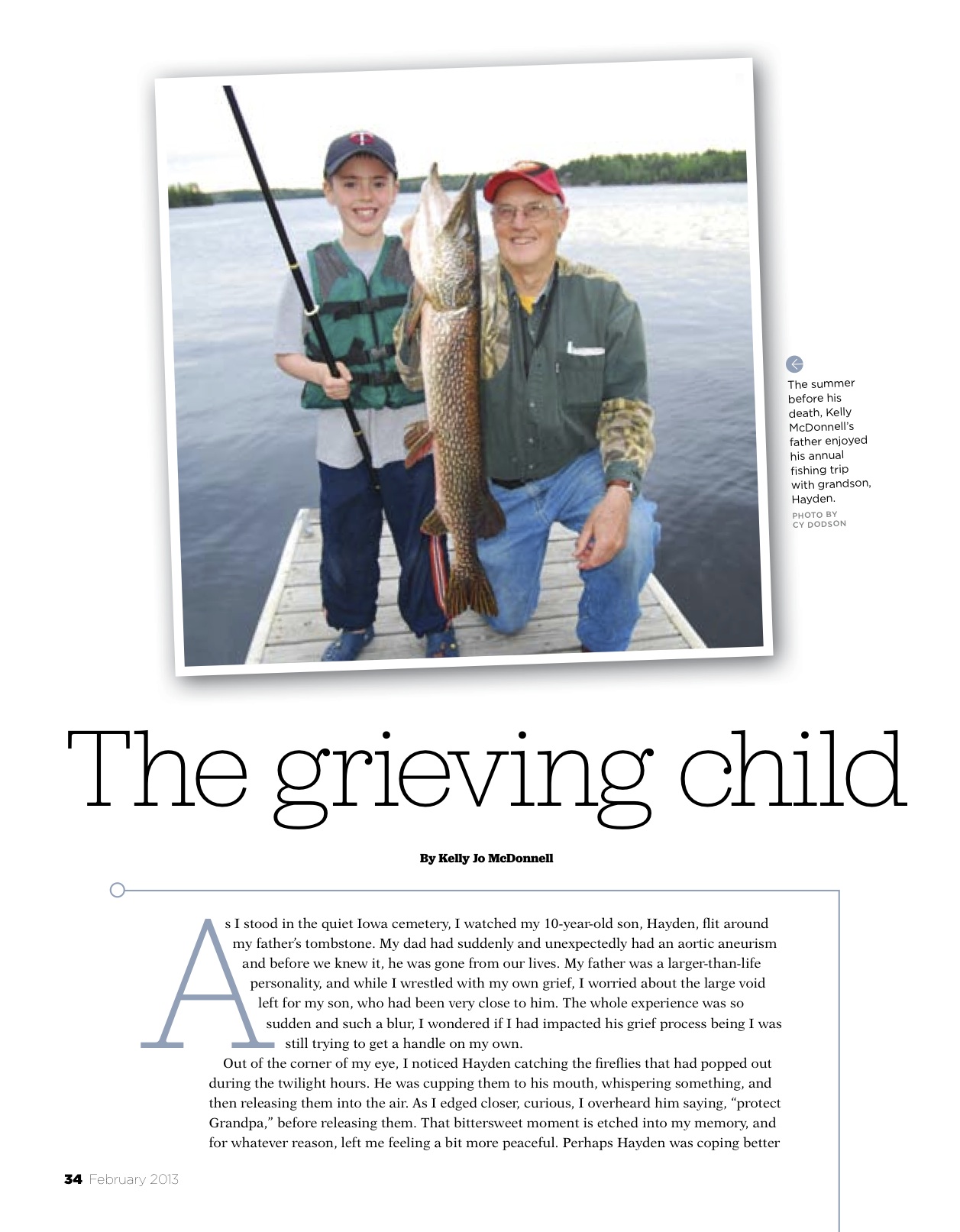
As I stood in the quiet Iowa cemetery, I watched my 10-year-old son as he flitted around my Father’s tombstone.  Grandpa had suddenly and unexpectedly had an aortic aneurism this year, and before we knew it, was gone from our lives.  My sons Grandpa was a larger than life personality, and while I wrestled with my own grief, I worried about the large void left for my son, who was 10 and had been very close to his Grandpa. The whole experience was so sudden and a blur, and I wondered if I had traumatized his grief process since I was still running to catch up with my own.

Out of the corner of my eye, I noticed Hayden catching the glowing fireflies that had popped out during the twilight hours. He was cupping them to his mouth, saying something, and then releasing them into the air. As I shuffled closer, curious, I over heard him whispering to the fireflies “Protect Grandpa”, before releasing them.  That bittersweet moment is etched into my memory, and for some reason, left me feeling a bit more peaceful. Perhaps Hayden was coping better than I had thought. Better than his Mother, anyway.

Grief is a tricky business, for both adults and children. And let’s face it; nothing prepares you for this business until your knee-deep in it.  But don’t make the mistake in thinking that kids don’t grasp the grieving process. Kids can grieve at any age, and it depends on their age, developmental stage and life experiences.

Inez Bersie-Mize, a licensed family therapist with Midwest Center in St. Paul, agrees that the child’s age makes a big difference. “Their cognitive abilities, and the ability to understand and comprehend makes a big difference,” she explained, “around 7 and 8 they still have that magical thinking, that the person could come back, or that ‘Grandpa looks like he’s sleeping’. It’s very common for that age to have that thinking. Their capacity to tolerate pain, and whom they have around them also makes a difference. Their relationship to the person who died comes into play.  Kids are very tuned into their sense of pain, and if they think the person died, had a great deal of pain or trauma, then they’ll have a harder time getting over it then someone who died in their sleep.”

Come to think of it, son Hayden’s first questions about Grandpa’s passing was pain-related.  Questions such as “Did it hurt?”  “Did Grandpa know what was happening to his heart?” Other kids, who have witnessed someone battle an illness, deal with different questions.  When Molly Sproull lost her Father to bone cancer, her son was 6 and daughter was in 3rd grade. “My Father was in hospice, so we all knew it was coming,” Sproull remembered, “So Ben got to say goodbye. I didn’t really pay much attention growing through the process. He was on his best behavior (during the illness) because of what I was going through. But after the funeral, that’s when he really started acting out.”

Sproull said the calls from teacher started coming soon after the funeral, and involved throwing objects and reacting to other kids. “I look back, and I realize he was grieving,” said Sproull, “he was just not himself.  I always tried to answer his questions (about Grandpa) without scaring him. It was hard. My daughter Abby had more tears. She understood a bit more, and I didn’t really see any negative reactions with her. She was more Mothering to me, asking if I was OK. She recognized I was grieving, even as a 3rd grader.”

Bersie-Mize said that’s the fine line that parents must walk while going through their own grief process. “It’s better to explain it then to hide it,” stressed Bersie-Mitze, “they need to know what’s happening, what the wake will look like, and have a choice to go or not to go. They need to be informed. A lot of kids fear crying, but when everyone else is crying, it helps them make that decision. They need to be informed.”

Brent and Christie Cuttell, Cottage Grove, are advocates of being informed. Brent lost his Father last year after an extended illness, and the couple’s three children range in age from 7 to teenagers.   “Kids grieve in a similar sense that we do, but it’s more pronounced. Everything a child does is more pronounced…they are louder and faster than we are, and their minds are sharper,” said Brent Cuttell, “youngest son Camden was 7 and a half when Grandpa died. He’s a visual kid, so whenever he sees a red hat, like his Grandpa Cuttell used to wear, he gets emotional. He’ll say ‘I miss Grandpa’, or “That guy in the red hat looks just like Grandpa’. They figure out that stepping stone – you have a Grandpa, you might even have a Great Grandpa. Now that Grandpa’s gone, that void is filled with Dad or Mom. That stepping stone and known, rock solid entity is gone.”

Christie Cuttell, who is a social worker at Psyche Recovery, Inc. in St. Paul, says her knowledge of the grief business helped her cope with her own family’s journey. “Americans are horrible at death and dying,” she explained, “we don’t like to talk about it, we don’t plan for it, yet it’s the only thing that is absolutely sure. It’s very frustrating when you work on death and dying. The more open we are with our kids and each other, the smoother it is going to go.”

She said youngest son Camden’s grief comes and goes in short waves and bursts, usually associated with visual triggers. “At first he was very careful not to grieve in front of us,” remembered Christie, “he didn’t want to upset people more. But when he went back to school and the teacher had given him an assignment to write about feelings, Camden could only get through 2 sentences, before he burst out crying.  I do think kids generally grieve better than adults. They are not at all selfish. Their genuine, and to them, it’s very literal.”

The Cuttell’s said their older teenagers took on a different grieving pattern.  “Myles, being the boy, was more non-verbal,” remembered Christie, “but his actions were kinder. He was not causing trouble, and would let things go that he usually wouldn’t. He was just quieter. Daughter Abby just cried her brains out, night and day. The teenaged kids had a very difference connection with Grandpa, as they are so much older than Camden. They saw Grandpa healthy, and he wasn’t sick in their memories.”

“Some of it is really just talking with them,” explained Bersie-Mize, “it really is. It’s OK that it hurts or that it’s scary. It’s OK to say those things to kids. The more they are involved in the planning, the better. It’s important not to exclude them from your own grief. Explain how you feel inside, so they don’t feel alone or isolated.”

Through the whole process, watch for warning signs of something deeper than “healthy” grief. “Watch how long they are staying in grief,” explained Bersie-Mize, “and if they are functioning in school and with friends. Are they isolating, or getting angry. Things like that should not be ignored, and sometime professional support is needed.”  Other factors to watch include inability to sleep, or loss of appetite, acting much younger for an extended period, repeated statements for wanting to join the dead person, or excessively imitating the deceased family member.

She went on to explain that it wasn’t until around the 1950’s or later that children were included at all in the whole grieving process, and until then was kept very separated from the whole ordeal. “Including them in the process, perhaps picking out flowers, or writing poems to put in the casket, are all closure activities. Talk about how sad it feels, and the hurt inside. Let them see the tears.”

With our family, we included all the grandsons as much as we could in the planning, and communicated what would be going on during the wake and the funeral itself. Hayden had the choice of viewing Grandpa during the wake. He sat in the back of the church in the last pew for a short time before making up his mind and marching up the aisle resolutely next to me. We also let each of the grandsons choose a “Grandpa treasure” from his dresser, and they all carried them in their pockets during the funeral. I noticed Hayden rubbing his Grandpa’s favorite pocketknife during the funeral.

After our visit to the cemetery that day, Hayden asked if Grandpa had known we were there visiting him, or if he was too busy up in heaven.

I guess only the fireflies and my dad really know the answer to that question.

Side Bar:

Kids books that help cope with grief:


The Fall of Freddie the Leaf – Leo Buscaglia


The Next Place – Warren Hanson


The Old Coyote by Nancy Wood


Papa’s New Home – Jessica Lynn Curtis

Iowa Corn & Wine

River valley holds simple pleasures

  • Article by: KELLY JO McDONNELL , Special to the Star Tribune
  • Updated: October 13, 2012 – 3:24 PM

This time of year, a mention of Iowa conjures up spent cornfields and soybeans harvests. But lush wine vineyards and rolling hills? Look closer at the northwest corner of our neighbor to the south, and

Photo: Cy Dodson

you’ll be surprised by what you find. Two sister towns, Peterson and Linn Grove, nestled next to the Little Sioux River, offer a charming getaway to enjoy a little history and the simple things in life.

THE BASICS

Peterson has the distinction of being Clay County’s first settlement, established in 1856 on the floor of the Little Sioux River Valley. Its neighbor city, Linn Grove, home to a historic dam, has been around since 1910. Both are as picturesque as a vintage Iowa postcard. And both sit right on the Iowa Glacial Trail Scenic Byway, a 36-mile loop that begins in Clay County on Hwy. 10.

WHAT TO DO

Fall suits this corner of Iowa perfectly. To see the area’s splendor up close, check out the wonders of the prairie at the Prairie Heritage Center, a few miles outside Peterson. The center offers environmental education and features a birding bonanza room with crafts and displays, including a section on the folklore of birds and how to “talk turkey.” Buffalo also roam the adjacent 160 acres (1-712-295-7200; http://www.prairie heritagecenter.org).

History is plentiful. Peterson Heritage Inc. can help set up a tour of Peterson’s historical gems — its office is located in one of the historic houses, the Boarding House of 1882. Other sights include the Fort Peterson Blockhouse, a fort constructed in 1862 by Civil War troops, and the Rock Forest School, one of the county’s first frame schoolhouses (1-712-295-8889; www. petersonhistory.org).

Jim’s History Barn in Peterson is an “American Pickers” dream. Owner Jim Hass has filled a restored 1928 barn from wooden floor to rafters with collections of western memorabilia, mounted wildlife, rows of military items from the 1700s through World War II and thousands of other items. Admission is free, and a bonus is that Hass is a font of knowledge on the area’s history (1-712-295-6551; http://www.peterson history.org).

Just a few miles from Linn Grove and Peterson farmlands is InnSpiration Vineyard, which covers 6 acres and whose tasting room overlooks a pond. Owners Paul and Sheila Thomsen have created a Midwest wine lover’s oasis, complete with acoustic music on weekends and annual grape stomps. Be sure to try the winery’s Touch of Sun, Squirrely Shirley or 2010 Frontenac Dry (1-712-296-4966; www.innspirationbandb.com).

Normally, the towns of Peterson and Linn Grove hover around a few hundred residents each. But if you roll into Peterson on the first Saturday of October next year, be prepared for the Hiney Wine & Arts Festival, which can draw 2,000 people. Crowds converge on Kirchner Park to browse artists’ wares and taste samples from beer and wine booths.

WHERE TO STAY

The InnSpiration Bed-and-Breakfast sits across the pond from the winery, and its four bedrooms feature queen beds, cozy fireplaces and double whirlpool baths. We stayed in the Lake Room, which overlooks both the rows of grapevines as well as the busy farm fields. From your deck, you might hear the soft bleating of sheep from the pastures. Breakfast included eggs Benedict, homemade jams, juice from the grapes and fresh honey from the owners’ beehives (www.innspirationbandb.com).

WHERE TO EAT

The area isn’t flush with the sort of dining choices we enjoy in the Twin Cities, but local eats aren’t hard to find. Lon’s Lounge is the place locals mention first for burgers and beer. It opened last October in Peterson’s quiet downtown. You’ll find owner Lon Frerichs waiting behind the bar as you enter. The Lon burgers were a finalist for the area’s “Best burger” in a contest by a local radio station (225 Main St.; 1-712-295-7006).

If you’re looking for a down-home breakfast, head to Sue’s Diner, right across the street from Lon’s (224 Main St.; 1-712-295-6231).

As many locals will remind you, it’s not a bad idea to call ahead before you make a trip. As Jim Hass at the History Barn explained, in this area, “businesses are open by appointment … and sometimes by chance.”

IF YOU GO

For more information about visitng the region, go to the website of the Clay County visitors bureau at http://www.explore claycounty.org.

Kelly Jo McDonnell is a freelance writer based in Lino Lakes.

Lake of the Woods

Respite on the Lake of the Woods

  • Article by: KELLY JO McDONNELL , Special to the Star Tribune
  • Updated: September 1, 2012 – 12:52 PM

With 135,000 miles of shoreline and 15,000 islands, Lac des Bois, otherwise known as Lake of the Woods, deserves its legendary reputation for scenery, fishing and relaxation-inducing powers. But if you can only taste a bit of it, the Sioux Narrows in Ontario is satisfyingly sweet.

THE BASICS

The Narrows got its name from the rocky, narrow channel that separates the south shore of Long Point Island from the Canadian mainland. A new bridge on Hwy. 71 has replaced a wooden bridge, which locals say was the longest single-span wooden bridge in the world. A fun little village is anchored on either side — voilà! The Sioux Narrows.

WHAT TO DO

One word says it all: fishing. Lake of the Woods is best known for its walleye population, but northern pike, perch, crappie, panfish, smallmouth bass, largemouth bass, lake trout and lake sturgeon also swim the waters. When the temperatures turn crisp, then it’s time to home in on the muskellunge, which are starting to bulk up for winter.

One doesn’t have to be a hard-core fisherman to experience these waters; there are lodges that offer boats and fishing guides who can take you to the honey hole of the day. Our guide was not only savvy at fishing, he knew the region’s history and pointed out abundant wildlife — which is another perk of Lake of the Woods.

Spotting local critters is downright easy here, and it’s a good idea to keep your eyes on the shoreline. The area is home to deer, bear, moose, eagles, wolf, lynx and fox, not to mention loons and many species of songbirds and waterfowl.

Kayakers love the shores of Berry Lake, Dryberry Lake, Black Lake, Blindfold Lake and Andy Lake. There are also many smaller rivers to explore. If you require a little more excitement, a tour company such as Green Adventures can help you out. Located right outside of Kenora, it can set you up to go rock climbing, kayaking, canoeing or paddleboarding (www.greenadventures.ca).

The Eco History tour offered by Totem Lodge is new this year. It includes a tour of ancient rock paintings and a World War II prisoner of war camp, where Canadians held German POWs. The guides also point out the lake’s diverse ecology, as well as the best wild rice patches and berry-picking spots. Participants, who don’t have to be guests of the lodge, can even add geocaching to the package. (Call 1-800-668-6836 for details.)

WHERE TO STAY

The Sioux Narrows area has a healthy selection of accommodations.

We nestled in at Totem Resorts; owners Eric and Sandra Brown also own neighboring lodges Yellowbird and Wiley Point. The cabins at Totem don’t disappoint — they offer the knotty pine, rustic feel but also have such amenities as air conditioning, color TVs and screened-in porches. Our little cabin was charmingly named “Little Joe.” Yellowbird Lodge & Chalet has a more luxurious feel, with a wedding party prepping for their big day on its shores during our visit. Fisherman parties tend to choose Wiley Point, the most secluded of the three (1-800-668-6836; www.totemresorts.com).

If you’d rather float, there are houseboats for rent. One company, Floating Lodges of Sioux Narrows, offers sprawling 60-foot houseboats as well as a cute 40-footer complete with picnic table on the top deck (1-800-743-5171; www. floatinglodges.com)

WHERE TO EAT

Locals recommend Big John’s Mineshaft. Not only is the food comforting, the view of the lake is fantastic as the Mineshaft sits right on the water at the Narrows bridge (20 Paradise Point; 1-807-226-5224). You can also find locals at the Dockhouse Sports Bar, the hot spot for wings and pizza (Hwy. 71; 1-807-226-3625).

But the Lake of the Woods experience isn’t complete without an old-fashioned fish fry on shore. Ours was included in the trip we arranged through Totem Lodge. The guide prepared lightly battered fresh fish, seasoned potatoes and canned baked beans, all cooked over an open flame, serving us a meal from a true Up North restaurant.

IF YOU GO

Visitors can find information at www.lakeofthewoods.com and www.snnf.ca, a site maintained by the Township of Sioux Narrows-Nestor Falls.

Kelly Jo McDonnell is a freelance writer based in Lino Lakes.